Watch These 6 Signs to Verify Dog Trainer Qualifications
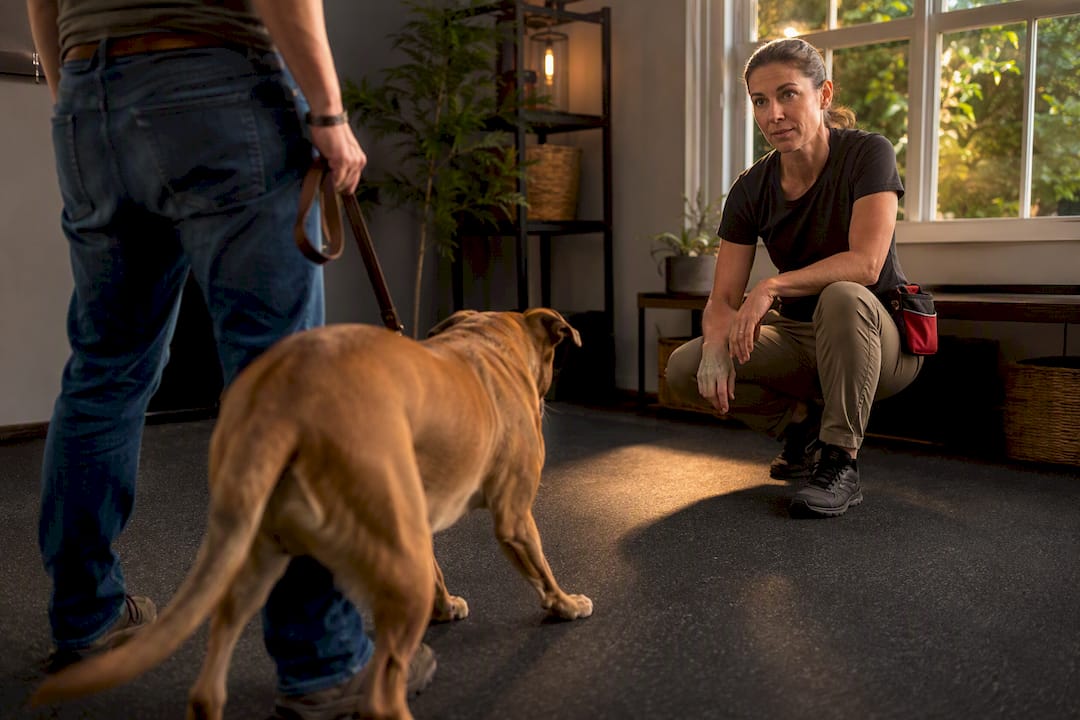
Any trainer worth hiring should show you four things without hesitation: humane, science-based methods; documented experience with cases like yours; a willingness to refer you elsewhere when a problem exceeds their scope; and proof they keep learning. Certificates matter, but only when paired with practice you can actually watch. Providers combining certification with extensive hands-on behavioural work illustrate what that combination looks like in real life.
TL;DR:
Verify that a trainer has recent continuing education and belongs to reputable professional bodies, not just certification credentials.
Observe sessions in person to assess how dogs respond and confirm a reward-based, humane approach rather than relying solely on marketing or equipment.
Ask specific questions about methods, follow-up support, tools, and scope to identify outdated practices and red flags like aversive techniques or dominance language.
Recognize that complex or sudden behavioral issues should lead to referral to a veterinarian or certified behaviourist, not standard training.
Confirm that trainers carry liability insurance, especially for in-home or board-and-train services, to protect against potential incidents.
Table of Contents
What dog trainer qualifications should you actually check for?
Certification tells you a trainer sat an exam. It doesn’t tell you whether they can read a frightened dog in your living room. The most useful qualifications checklist blends paperwork with observable skill, because either one alone leaves gaps a nervous owner can’t afford; for managing behavioural issues in your home, see this guide to the best rugs for dogs.
Start with accreditation itself. Independent certification, ideally through a recognised veterinary-linked body, usually means the trainer has logged supervised hours, passed a practical or written assessment, and agreed to a code of ethics. That last part matters more than it sounds. A code of ethics is what stops a trainer from using fear or pain to get quick results, and it’s the difference between someone who trains dogs and someone who trains dogs responsibly.
Alignment with the AVSAB position statement on choosing a trainer is worth checking directly, because the American Veterinary Society of Animal Behavior explicitly warns against choke, pinch and shock collars and explains the welfare risks behind that advice. If a trainer’s marketing echoes this thinking, that’s a good sign. If it contradicts it, that’s your answer.
Beyond paper credentials, look for:
Practical experience with your specific problem. Ask for case summaries involving separation anxiety, aggression, or fearfulness, not just basic obedience.
Continuing education as a live habit, not a past event. Whole Dog Journal treats recent courses, conference attendance and published case notes as strong signals of current, science-based practice.
Membership of a reputable professional body, which usually requires ongoing education to maintain.
The ability to teach owners, not just dogs. Small class sizes or assistant support usually mean you’ll get real coaching, not a demonstration you can’t replicate at home.
Pro Tip: Ask a trainer when they last attended a course or workshop. Hesitation or a vague answer usually means their methods stopped updating years ago.
How do you verify a trainer’s methods in person?
Reading a website is not the same as watching a session, and the gap between the two is where misleading marketing hides. The American Kennel Club recommends observing a trainer in action specifically because some trainers advertise as “positive” while still relying on aversive corrections behind closed doors.
Here’s how to check properly:
Ask to observe a class or session before booking. A confident, ethical trainer will welcome this. Reluctance is itself a data point.
Watch how the dogs respond. Loose bodies, wagging tails and voluntary engagement mean the dog feels safe. Freezing, flinching, or a hard stare toward the handler suggests something less pleasant is happening.
Check the equipment on the table. Treats, toys and clickers signal reward-based work. Choke, prong or shock collars are a hard stop, according to the AVSAB position statement.
Ask directly: “What happens when my dog makes a mistake?” A trainer focused on teaching replacement behaviours will describe redirection and reward. One focused on correction will describe punishment, even softened with friendly language.
Request references for a case similar to yours, and actually call them. Ask what changed, how long it took, and whether the trainer stayed in touch afterwards.
Confirm continuing education and membership by asking which organisation they belong to and when they last renewed it.
What questions and red flags should guide the hire?
A short phone call can tell you most of what you need. Ask these six questions and listen closely to how they’re answered, not just what’s said:
“What training methods do you use, and can I watch a session?”
“What’s my role as the owner during and after training?”
“What follow-up support is included once the programme ends?”
“What tools or equipment will you use with my dog?”
“Do you guarantee results, and if so, what does that mean exactly?”
“If my dog’s issue turns out to be medical or beyond your scope, what happens next?”
Stop the process immediately if you hear insistence on aversive collars, “pack leader” or “dominance” language, refusal to let you observe, or a guaranteed outcome. The AVSAB and the MSPCA both flag dominance rhetoric as a marker of outdated, often aversive practice. Evasive answers deserve the same treatment as bad ones. If someone dodges a direct question about corrections, ask again, and if the dodge continues, walk away.
When does a case need a vet or behaviourist instead?
Sudden behaviour changes, intense fear responses, self-harming behaviour, or aggression that escalates quickly often point to medical causes or a problem beyond standard training. A dog that suddenly snaps at a family member after years of gentle temperament, for instance, needs a veterinary check before any training plan makes sense.
Board-certified behaviourists hold veterinary or academic credentials that qualify them to diagnose and treat complex behavioural conditions, often alongside medication where appropriate. A good trainer knows this boundary and treats it seriously. Behaviour specialists agree that recognising when a case sits beyond a trainer’s scope and referring onward is itself a mark of competence, not a failure. Ask how the trainer documents and communicates referrals. A written note to your vet, rather than a vague verbal suggestion, shows they take the handoff seriously.
How do you evaluate a board & train programme safely?
Sending your dog away for intensive training can work well, but only with real accountability built in. Before you commit, ask:
Are only force-free techniques used during boarding, and how are staff supervised while you’re not there?
Will you receive a written, owner-focused handover plan with measurable goals, not just a verbal “he’s doing great”?
What follow-up coaching is included once your dog comes home, and for how long?
How does the programme handle setbacks once your dog is back in a different environment?
The MSPCA is clear that board & train providers should still rely on reward-based methods and provide a proper handover plan, not just a trained dog handed back with no instructions. Our guide to board and train success factors covers this in more depth if you’re weighing that option specifically. Be wary of absolute guarantees. Dogs are individuals, and any provider promising a fixed outcome is usually promising more than behaviour science can deliver.
What does a genuinely qualified provider look like?
A qualified trainer who holds accreditation and brings extensive experience with obedience, fearfulness and aggression cases, backed by ongoing support after training ends, reflects the standards this article has laid out. That combination of accreditation, specialised behavioural focus and ongoing availability reflects the standards this article has laid out.
You can verify claims like these the same way you’d verify any trainer’s: ask to see certification directly, request a case summary relevant to your dog’s issue, and ask to observe a session before booking. For readers weighing options, the relevant services include behaviour consultations, AVS-mandated obedience programmes, and board & train, each worth discussing directly before committing.
Do trainers need insurance, and why does it matter to you?
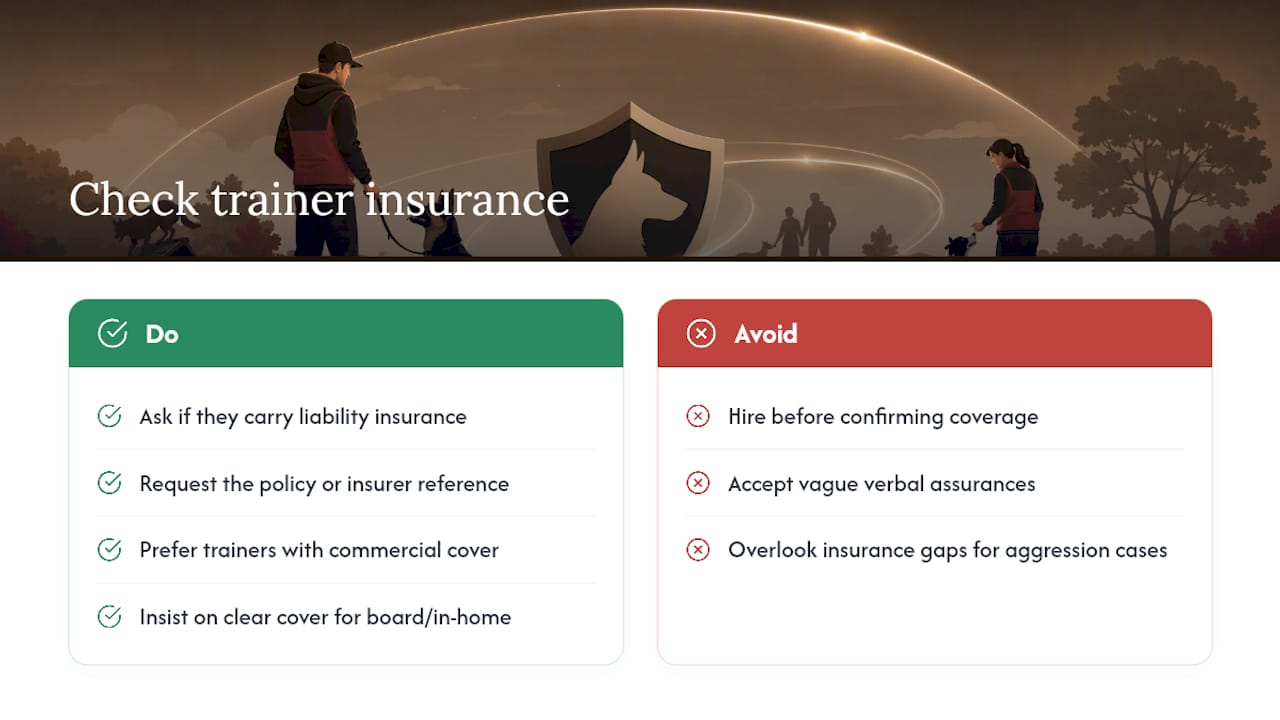
Professional liability insurance protects both you and the trainer if something goes wrong during a session, a dog bite, a property mishap, or an injury during handling. A trainer without any liability cover is taking a risk they’re effectively transferring onto you, since you’d have limited recourse if an incident occurred on your property or theirs.
Reputable trainers typically carry commercial liability insurance as a basic condition of operating, often as a requirement of the professional bodies they belong to. It’s reasonable to ask directly whether a trainer carries coverage, particularly if you’re booking in-home sessions or a board & train stay where your dog will be in someone else’s care for days at a time. A trainer who answers this confidently, with a policy they can reference, is signalling that they run their business properly, not just their training sessions.
This matters more with higher-risk cases. Aggression work in particular carries real physical risk to the trainer, your dog, and anyone in the vicinity. If a trainer working with a bite case can’t speak clearly about their insurance position, treat that as a gap worth asking more about before you commit, not something to overlook because the rest of the conversation went well.
Why owner-led verification beats credential-checking
The conventional advice on this topic stops at “check their certification,” and that advice undersells what actually protects your dog. A certificate proves someone passed a test once. It says nothing about whether they’ve kept learning, whether they can read your specific dog’s stress signals, or whether they’ll admit when a case is beyond them.
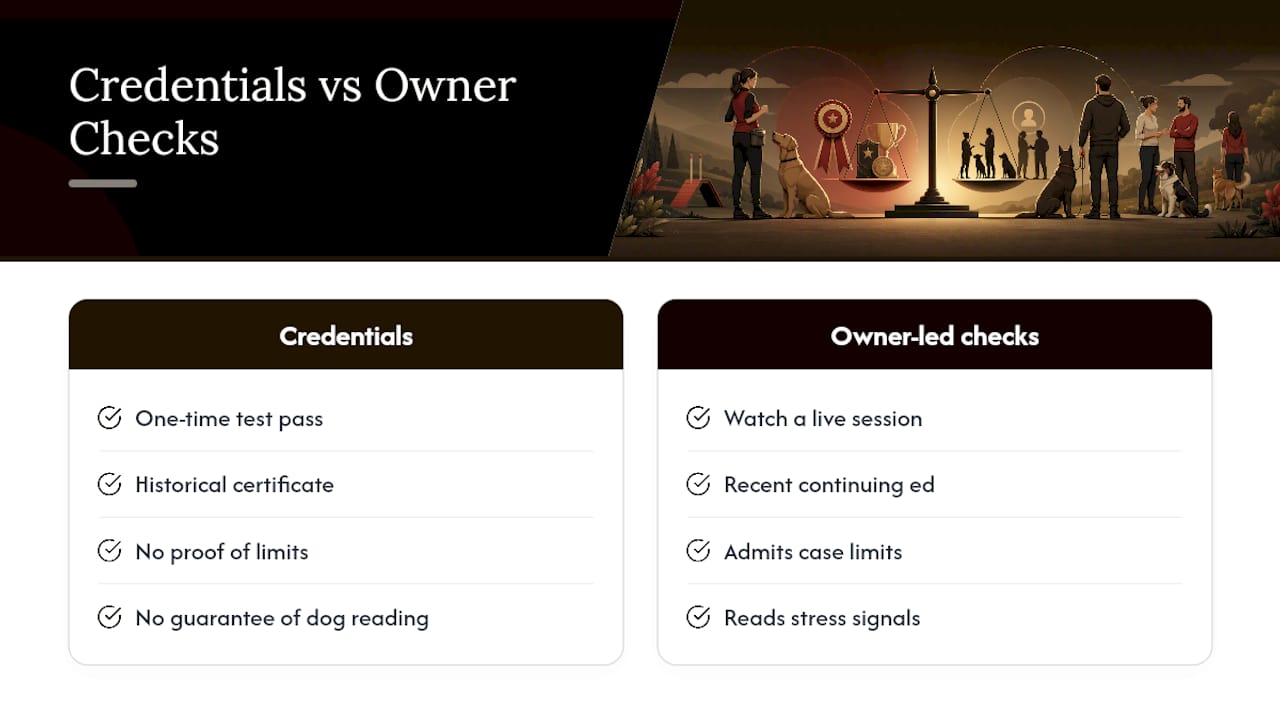
What the research actually supports is a shift in effort: spend less time hunting for the right acronym and more time watching a live session, asking the mistake question, and checking whether continuing education is recent rather than historical. A trainer who welcomes observation and answers direct questions plainly is telling you more than any qualification list could.
The overrated skill in this whole process is credential literacy. The underrated one is owner confidence, knowing what a stressed dog looks like, knowing what a real answer to “what happens when my dog makes a mistake” sounds like, and being willing to walk away from a confident evasion. Prioritise that first. The paperwork can wait until you’ve watched the trainer work.
— Mark
Ready to book a trainer who meets this standard?
A reputable training service provides a certified, accredited trainer with extensive behavioural experience and ongoing support after your programme ends, so questions don’t stop the day training does. Whether your dog needs help with obedience, fearfulness, or aggression, the approach stays rooted in reward-based methods you can watch and verify for yourself.

Before booking anywhere, insist on the same verification steps covered above, ask to observe, ask about corrections, ask for referral practice. If you’d like to see how a structured, AVS-approved plan works in practice, take a look at the 4-week AVS-approved intensive obedience programme, or visit the Happy-Dog Training Singapore homepage to arrange an assessment call and ask your own questions directly.
Where these standards come from
The AVSAB position statement covers aversive-method risks; MSPCA guidance covers observation and referral; the AKC covers credentials and verification; Pet Professional Guild and Whole Dog Journal cover ongoing education standards.
Sources
Recommended
Comments