How puppy learning works: a new owner's guide
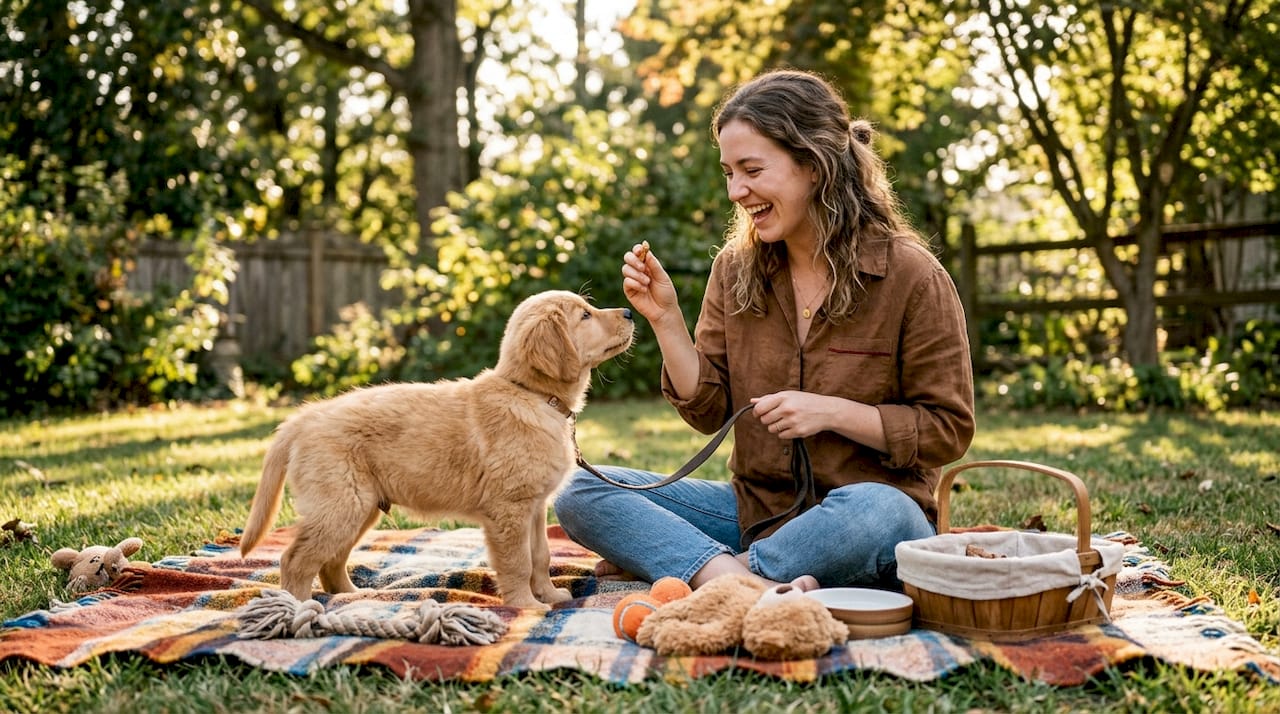
Puppy learning is defined as the process by which dogs acquire behaviour, social skills, and responses through developmental stages and associative conditioning. Understanding how puppy learning works gives you a real advantage from day one. Key cognitive abilities emerge rapidly between 8 and 16 weeks, making early experiences extraordinarily powerful. The principles behind this process, classical conditioning, operant conditioning, and socialisation, are well-established in animal behaviour science. Get them right early, and you set your puppy up for a lifetime of confidence and good behaviour.
How puppy learning works: developmental stages explained
Puppy development is not a smooth, even curve. Skills emerge at specific points, and knowing when to expect them helps you train at the right moment rather than pushing too hard too soon.
A landmark study at Duke University tracked 101 puppies and found that 9 of 10 key abilities appeared by around 16 weeks of age. That is a remarkably short window. Eye contact, one of the most important foundations for training, emerged around weeks 10 and 11. Bladder control, which every new owner cares deeply about, arrived closer to week 14. Understanding human pointing, a surprisingly sophisticated social skill, appeared as early as 8 weeks.
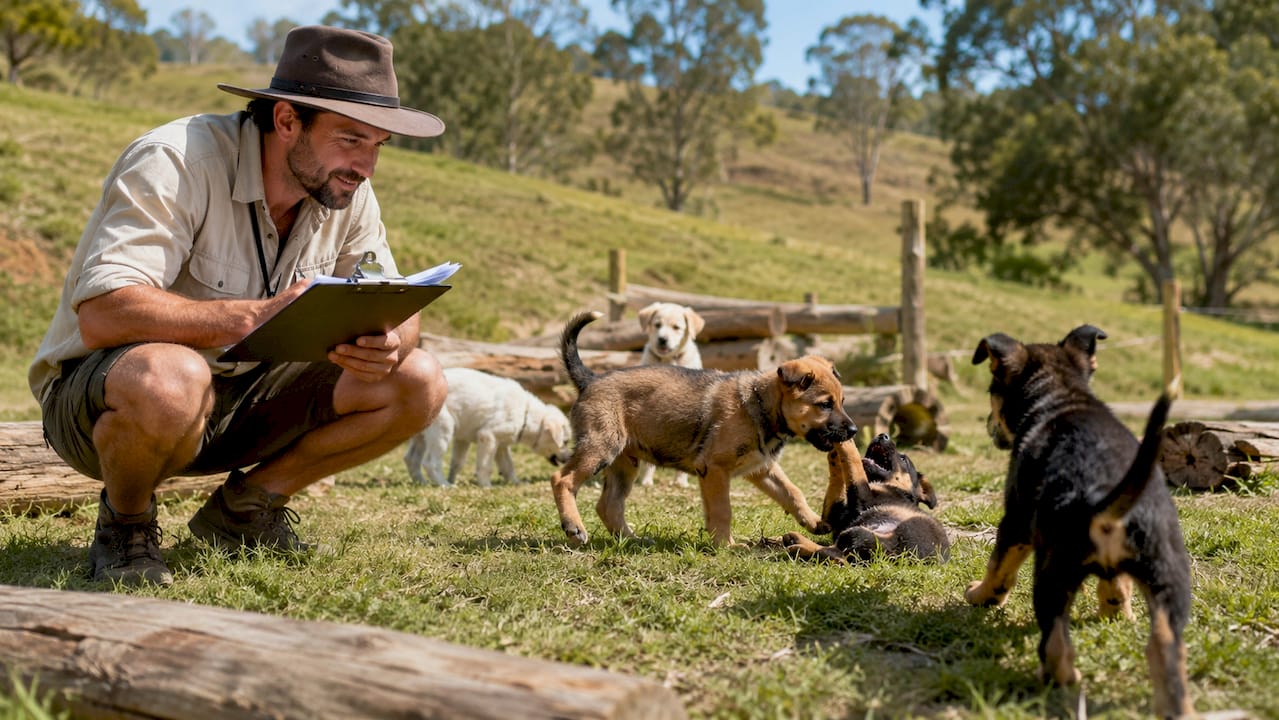
This uneven emergence matters. If your puppy struggles with a task, the most likely explanation is developmental timing, not stubbornness or a training failure. Lowering training difficulty during these gaps is far more productive than repeating commands with greater force.
Developmental Milestone | Approximate Age |
Understanding human pointing | ~8 weeks |
Eye contact with humans | ~10–11 weeks |
Bladder control | ~14 weeks |
Most key social abilities present | ~16 weeks |
The socialisation sensitive window runs roughly from 3 to 14 weeks and closes gradually rather than abruptly. Positive experiences during this period shape how your puppy expects the world to behave for the rest of its life. Missing this window does not make socialisation impossible, but it does make it slower and harder. Think of it as a door that swings mostly shut, not one that slams.
How do classical and operant conditioning shape puppy behaviour?
Two learning engines drive almost everything that happens in puppy training. Understanding both gives you a clear picture of why certain techniques work and others do not.

Classical conditioning pairs two stimuli together until a neutral cue triggers a reflex response. The classic example is Pavlov’s dogs salivating at a bell. In puppy training, this shows up when your puppy learns that the click of a clicker or the rustle of a treat bag means something good is coming. The sound itself becomes rewarding before any treat appears.
Operant conditioning works differently. It links a behaviour to its consequence, increasing or decreasing how often that behaviour occurs. Reward a sit and the puppy sits more. Ignore jumping and jumping fades. These two mechanisms are not separate tools. They work together constantly during every training session you run.
Here is what this means in practice:
Reward timing matters enormously. The reward must follow the desired behaviour within one to two seconds to create a clear association.
Consistency is not optional. Rewarding a behaviour sometimes and ignoring it other times creates confusion, not learning.
Early motivation is broad. Affection, treats, and toys all work as reinforcers. You can find out which your puppy values most and use that knowledge strategically.
Punishment weakens the bond. Aversive consequences can suppress behaviour, but they also create fear and erode trust, which undermines every other aspect of training.
Pro Tip: Use a short, consistent marker word like “yes” or a clicker the instant your puppy performs the right behaviour. This bridges the gap between the action and the reward, making the association crystal clear.
For a deeper look at humane training methods and how they apply these principles, the Happy-dogtraining resource library is a practical starting point.
What are the best socialisation strategies during the sensitive period?
Socialisation is one of the most misunderstood parts of raising a puppy. Many owners assume it means letting their puppy meet as many dogs and people as possible, as quickly as possible. That approach often backfires.
True socialisation means teaching calm, relaxed engagement with the world, not forced play or overwhelming exposure. The American Animal Hospital Association recommends controlled, brief, positive meetings with people and animals when it is medically safe. Brief and positive are the key words here.
Follow these steps to socialise your puppy effectively:
Start at a distance. Introduce new stimuli from far enough away that your puppy notices but stays calm. A relaxed puppy is a learning puppy.
Watch for stress signals. Yawning, lip licking, turning away, and freezing all indicate your puppy is at or beyond its comfort threshold. Back off immediately.
Use treats, toys, and praise. Pair every new experience with something your puppy loves. This builds a positive emotional association with novelty itself.
Reintroduce gently after a setback. If your puppy shows fear, do not push through. Return to a greater distance and rebuild confidence slowly.
Prioritise calm leadership. Your puppy takes emotional cues from you. A relaxed, confident owner creates a relaxed, confident puppy.
Pro Tip: Carry high-value treats on every outing during the sensitive period. The moment your puppy notices something new and looks at you calmly, reward that choice. You are teaching your puppy that checking in with you is the best response to novelty.
Excessive exposure that pushes beyond your puppy’s coping threshold creates fear associations that make re-socialisation slower and harder. One bad experience during the sensitive period can outweigh dozens of good ones. Slow and steady genuinely wins this race.
For guidance on timing socialisation around your puppy’s health needs, the Happy-dogtraining vaccination and socialisation guide covers both aspects together.
How can you use environment and motivation to support training?
Managing your puppy’s environment is as important as any command you teach. A puppy that practises an unwanted behaviour repeatedly becomes better at it. Prevention is training.
The AKC recommends puppy-proofing the environment to prevent rehearsal of unwanted behaviours during early learning. Crates, pens, and baby gates are not punishments. They are management tools that keep your puppy safe and stop bad habits from forming while good ones are still being built.
Approach | When to Use It | What It Achieves |
Crate training | Unsupervised periods, night-time | Prevents problem behaviour, supports toilet training |
Puppy pen | When you cannot watch closely | Contains the puppy safely without isolation |
Baby gates | Room boundaries | Limits access to areas where problems occur |
Scheduled routines | Feeding, toilet, play, sleep | Aligns training with natural learning readiness |
Motivation management follows a clear progression. Begin with treats and affection as soon as your puppy arrives home, rewarding successes immediately and consistently. As a behaviour becomes reliable, shift gradually from treats to praise. This shift prevents your puppy from only performing when food is visible.
High-value treats become especially important as training difficulty increases. Teaching a recall in a quiet room requires less motivation than practising it near a distracted, exciting environment. Match the reward to the challenge, and your puppy will stay engaged.
Routines also play a quiet but powerful role. A puppy that eats, sleeps, plays, and toilets at consistent times develops predictable patterns of alertness and readiness. Training sessions land better when your puppy is neither exhausted nor overstimulated. Ten minutes of focused, rewarding practice beats an hour of frustrated repetition every time.
For enrichment activities that support learning between formal sessions, structured play and problem-solving games keep your puppy’s mind active and build confidence.
Key takeaways
Puppy learning is shaped by developmental timing, associative conditioning, and consistent environmental management, and getting all three right in the first 16 weeks produces lasting results.
Point | Details |
Development is rapid and uneven | Most key abilities emerge between 8 and 16 weeks; adjust training difficulty to match your puppy’s current stage. |
Two mechanisms drive all learning | Classical conditioning builds associations; operant conditioning links behaviour to consequences. Use both deliberately. |
Socialisation requires calm, not chaos | Introduce new experiences gradually and positively; back off at the first sign of fear or overarousal. |
Environment prevents bad habits | Crates, pens, and routines stop unwanted behaviours from being rehearsed and reinforced by accident. |
Motivation must be matched to difficulty | Use high-value treats for harder tasks and shift to praise once behaviours are reliable and consistent. |
What i have learned after 20 years of puppy training
The single biggest mistake I see new owners make is treating a developmental setback as a character flaw in their puppy. A puppy that cannot hold its bladder at 10 weeks is not being difficult. It simply does not have the physical capacity yet. When you understand that, you stop feeling frustrated and start feeling curious. That shift changes everything.
The second thing I have come to believe strongly is that socialisation quality matters far more than quantity. I have worked with dogs whose owners took them everywhere as puppies, to markets, parks, and busy streets, and those dogs were anxious wrecks because every outing was overwhelming. Contrast that with a puppy whose owner introduced one new thing per day, calmly and with treats, and you see a completely different animal at six months old.
Positive reinforcement is not just kinder than punishment. It is faster. Puppies trained with reward-based methods learn new behaviours more quickly and retain them more reliably. The science on this is clear, and two decades of working with dogs in Singapore has only confirmed it for me personally.
My honest advice: invest your energy in the first 16 weeks as if nothing else matters, because in terms of your puppy’s long-term behaviour, almost nothing else does. Get the essential training steps right early, and you will spend far less time correcting problems later.
— Mark
Ready to give your puppy the best start?
Understanding the science behind puppy learning is the first step. Putting it into practice with expert guidance is what makes the real difference.
Happy-dogtraining has over 20 years of experience helping new puppy owners in Singapore build confident, well-behaved dogs through humane, science-based methods. Every programme is tailored to your puppy’s individual needs, covering socialisation, obedience, and behaviour management in a structured, positive environment. Whether you are starting from scratch or working through a specific challenge, the team provides free lifetime support after training so you and your puppy continue to thrive. Visit Happy-dogtraining to find the right programme for your puppy and take the first step towards wagging tails and joyful moments together.
FAQ
When does the puppy socialisation window close?
The socialisation sensitive period runs roughly from 3 to 14 weeks and closes gradually. Socialisation after this window is still possible but requires more time and patience.
What is the difference between classical and operant conditioning?
Classical conditioning pairs stimuli to create automatic responses, such as a clicker predicting a treat. Operant conditioning links behaviour to consequences, rewarding desired actions to increase how often they occur.
How do i know if my puppy is overwhelmed during socialisation?
Watch for yawning, lip licking, turning away, or freezing. These are stress signals. Back away from the stimulus immediately and reintroduce it from a greater distance on another occasion.
Why does my puppy seem to forget training it already knew?
Developmental timing often explains apparent regression. Cognitive skills mature unevenly, so lowering training difficulty temporarily is more productive than repeating commands with more pressure.
How soon should i start training my new puppy?
Begin training immediately when your puppy arrives home, using treats and affection to reward correct behaviour. Short, positive sessions of five to ten minutes are far more effective than long, tiring ones.
Recommended
Comments