How residential dog training works: a clear guide
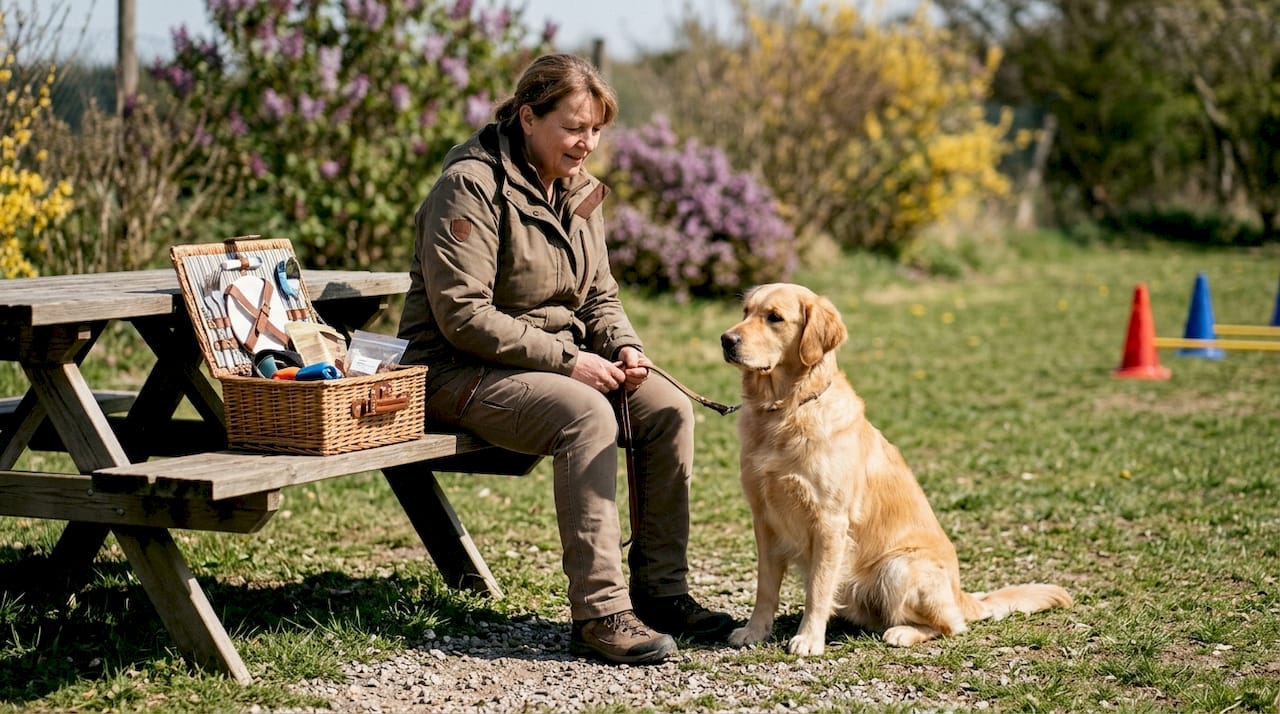
Residential dog training is defined as an immersive programme where your dog lives with a professional trainer for an intensive period, receiving expert-led behaviour modification and obedience instruction every single day. Also known as board-and-train or dog boot camp, this approach delivers 2 to 6 weeks of structured, consistent coaching that simply cannot be replicated in a one-hour weekly class. The results can be remarkable, but the method works best when you understand what happens during the programme, what to expect at handover, and what your role is once your dog comes home.
How residential dog training programmes typically work
A well-run residential programme is built around structure, repetition, and real-world exposure. Your dog does not simply sit in a kennel waiting for a daily lesson. The daily routine includes multiple short training sessions, play, rest periods, and carefully managed socialisation. This rhythm mirrors how dogs naturally learn: through consistent, repeated experiences rather than occasional bursts of instruction.
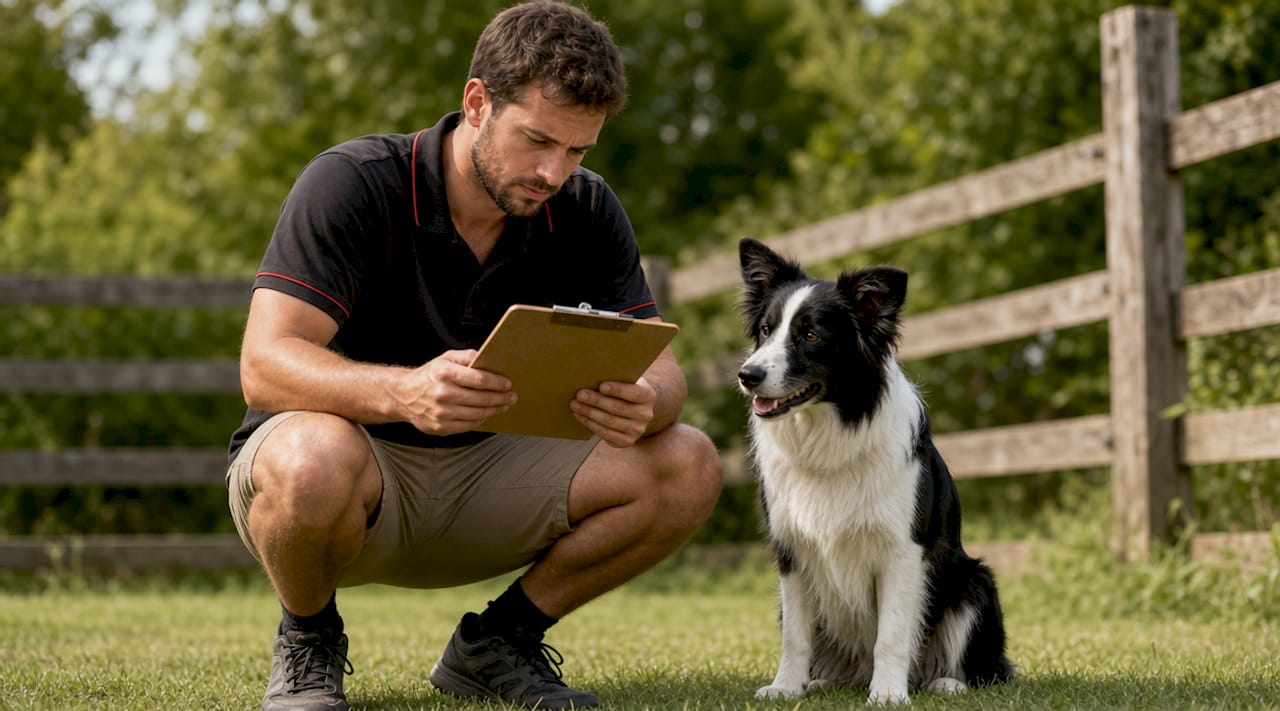
The length of a programme depends on your goals. Basic obedience for a young, eager dog might take two to three weeks. Complex behavioural rehabilitation, such as fear-based reactivity or aggression, often requires four to six weeks or more. Trainers provide 24/7 supervision to prevent accidental reinforcement of unwanted behaviours, which is one of the most significant advantages over owner-led training at home.
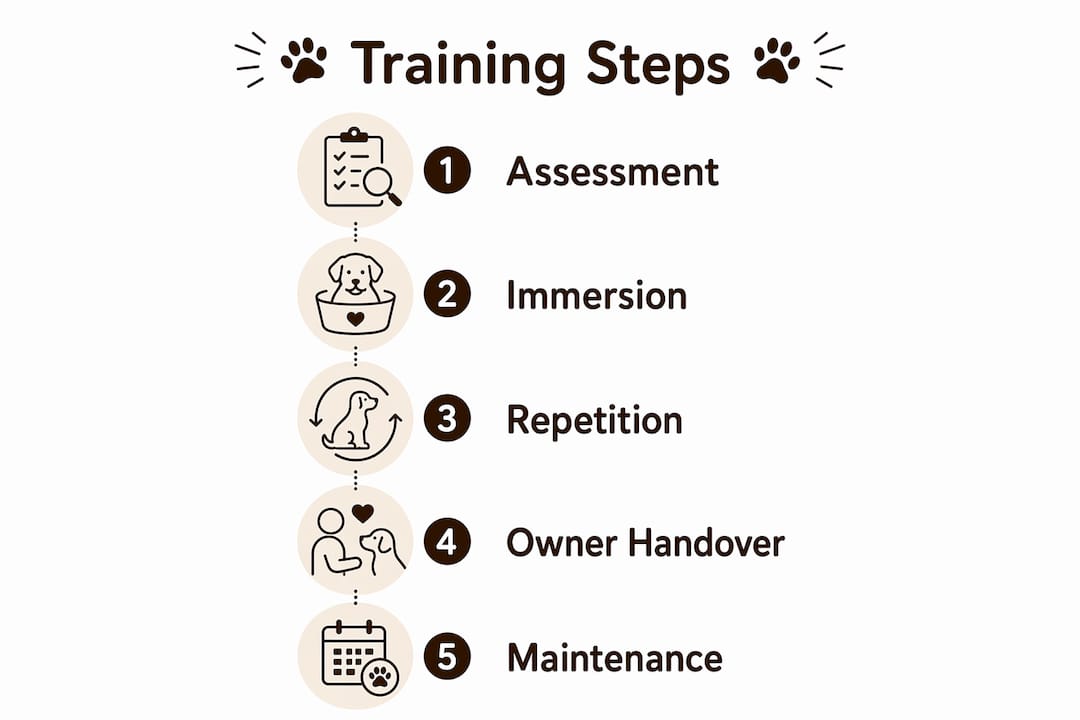
Here is what a typical residential programme looks like from start to finish:
Initial assessment. The trainer evaluates your dog’s temperament, triggers, and existing skills before designing a personalised plan.
Foundation building. Early sessions focus on basic commands, impulse control, and building trust between dog and trainer.
Skill development. As confidence grows, the trainer introduces more complex behaviours and begins proofing them in different environments.
Real-world proofing. A reputable programme includes training in parks, shops, and busy neighbourhoods so skills generalise beyond the training facility.
Owner handover. You attend one-to-one sessions to learn the commands, routines, and handling techniques your dog now responds to.
Follow-up support. Good programmes provide written or video guides and ongoing access to the trainer after your dog returns home.
Pro Tip: Ask any residential trainer how much time is dedicated to owner handover before you book. A programme with no structured handover is a red flag, regardless of how impressive the training itself sounds.
Is residential training more effective than weekly classes?
The short answer is yes, for the right dog and the right problem. Immersive residential training accelerates learning by approximately 75% compared to weekly classes, thanks to the consistency and repetition that 24/7 expert supervision provides. A typical owner manages around 10 training repetitions per day. A residential trainer delivers many times that number, across varied settings and situations.
Weekly classes have genuine value for puppies, social dogs, and owners who want to be hands-on from day one. Residential training, however, is most effective for dogs with emotional regulation challenges or entrenched problem behaviours, and for owners who have tried periodic classes without meaningful progress.
Factor | Weekly classes | Residential training |
Training frequency | Once per week | Multiple sessions daily |
Owner involvement | High throughout | Concentrated at handover |
Best suited for | Puppies, social dogs | Reactive, anxious, or complex cases |
Behaviour generalisation | Gradual, owner-dependent | Proofed across real-world settings |
Speed of progress | Slower, incremental | Significantly accelerated |
One misconception worth addressing directly: residential training is not about “sending your dog away to be fixed.” It is immersive coaching for both the dog and the owner. The handover phase is where your learning begins, and your commitment after collection determines whether the gains last.
“The transition home phase is often the most overlooked part of the entire process. Without it, even the best residential programme can unravel within weeks.”
The mental enrichment built into residential programmes also helps reduce destructive behaviours caused by anxiety and boredom. Dogs that chew furniture, bark incessantly, or pace are often under-stimulated. A structured residential programme addresses the root cause, not just the symptom.
What training methods are used in residential programmes?
Positive reinforcement is the gold standard for residential dog training in 2026, and modern veterinary behaviourists endorse reward-based methods exclusively. This means your dog learns through rewards: treats, praise, play, and calm affirmation. Desired behaviours are marked and rewarded immediately, which builds clear communication and genuine confidence in your dog.
Reputable trainers reject punitive or dominance-based approaches for good reason. Shock collars, choke chains, and so-called “alpha” techniques carry documented risks of increasing fear and aggression. They may suppress behaviour in the short term, but they do not teach the dog what to do instead. The result is a dog that complies out of anxiety rather than understanding.
Here is what ethical, evidence-based residential training includes:
Marker training. A clicker or verbal marker (such as “yes”) signals the exact moment a correct behaviour occurs, making learning faster and clearer.
Reward-based obedience. Commands like sit, stay, recall, and loose-lead walking are taught through consistent positive association.
Behavioural management strategies. Trainers use environmental controls and coping exercises to reduce triggers while new skills are being built.
Mental enrichment activities. Puzzle feeders, scent work, and structured play keep the dog engaged and reduce anxiety-driven behaviours.
Coping skills for emotional regulation. Dogs with fear or reactivity learn to settle, disengage from triggers, and self-regulate through calm, repeated exposure.
You can read more about the principles behind these approaches in this guide to humane training methods to understand why reward-based techniques produce lasting results.
Pro Tip: Before enrolling in any residential programme, ask the trainer to describe exactly how they handle a dog that refuses to comply. The answer tells you everything about their methods.
How do you maintain your dog’s progress after training?
Without consistent follow-through from you at home, behavioural improvements from residential training can dissipate quickly. This is not a flaw in the training. It is simply how behaviour works. Dogs respond to the environment they are in, and if that environment changes significantly when they return home, old habits can resurface.
The good news is that maintaining progress is straightforward when you approach it with consistency and patience. Here is what works:
Attend every handover session. These one-to-one coaching sessions are where you learn the exact commands, cues, and handling techniques your dog now understands. Missing them is the single biggest mistake owners make.
Use the same commands consistently. If the trainer used “down” and you switch to “lie down,” your dog is not being stubborn. The cue simply does not match what was trained.
Practise daily in short sessions. Ten to fifteen minutes of focused practice each day maintains muscle memory and keeps skills sharp. Sporadic long sessions are far less effective.
Reinforce boundaries in all settings. Your dog needs to understand that the rules apply at home, in the park, at a friend’s house, and everywhere else. Vary your practice locations regularly.
Watch for early signs of regression. If your dog starts ignoring a previously reliable command, address it immediately with a refresher rather than waiting for the behaviour to fully break down.
Use your follow-up support. A good trainer provides ongoing access after the programme ends. Use it. Asking for a refresher session or a quick video call is far easier than retraining from scratch.
Pairing consistent training with good nutrition for training success also supports your dog’s focus and energy levels during daily practice sessions at home.
If your dog came home from a residential programme and you are seeing some confusion or hesitation, read this guide on preparing for board and train for practical tips on setting the right conditions from day one.
Key takeaways
Residential dog training works because it combines 24/7 expert supervision, positive reinforcement, and real-world proofing with a structured owner handover that makes lasting behaviour change possible.
Point | Details |
Immersive structure | Dogs receive multiple daily training sessions, not just one, accelerating progress significantly. |
Positive reinforcement only | Reward-based methods build trust and lasting behaviour change without fear or anxiety. |
Real-world proofing | Skills are practised in parks, shops, and neighbourhoods so they generalise reliably. |
Owner handover is critical | One-to-one coaching at collection ensures you can maintain every gain your dog has made. |
Consistency at home | Daily short practice sessions and consistent commands preserve results long after training ends. |
What I have learned from two decades of residential training
After more than 20 years working with dogs and their owners, the thing that surprises people most is this: the dog is rarely the hardest part of the equation. Dogs adapt quickly. They are remarkably good at reading structure and responding to clear, kind communication. The harder work is often with the owner, and I say that with genuine warmth, not criticism.
The owners who see the best long-term results are not the ones with the most obedient dogs at handover. They are the ones who show up to every handover session, ask questions, practise daily, and treat the training as a partnership rather than a service they purchased. I have seen beautifully trained dogs regress within a month because the owner reverted to old habits. I have also seen dogs with serious reactivity issues thrive for years because their owner stayed consistent and reached out for support when needed.
The other thing I want to be honest about: residential training is not the right choice for every dog or every situation. For a young puppy with no significant behavioural issues, a good obedience training programme with regular owner involvement may serve you better. Residential training shines brightest when the problem is complex, when previous attempts have stalled, or when an owner’s schedule genuinely prevents the daily consistency that good training requires.
Choose your trainer carefully. Ask about their methods, their handover process, and what support looks like after the programme ends. A trainer who cannot answer those questions clearly is not the right fit, regardless of how impressive their testimonials appear.
— Mark
Ready to explore residential training for your dog?
If your dog is struggling with reactivity, anxiety, obedience, or any behavioural issue that feels stuck, Happy-dogtraining offers AVS-accredited residential programmes built on over 20 years of experience with Singapore’s dogs and their families.

Every programme at Happy-dogtraining is personalised to your dog’s specific needs, using humane, science-based methods and a thorough owner handover to set you both up for lasting success. Free lifetime support is included after every programme, so you are never left managing alone. For dogs with reactivity or aggression, the 4-week intensive programme is a proven starting point. Reach out today to discuss whether residential training is the right step for your dog.
FAQ
What is residential dog training?
Residential dog training is a programme where your dog lives with a professional trainer for two to six weeks, receiving intensive daily behaviour modification and obedience instruction. It is also called board-and-train or dog boot camp.
How long does a residential dog training programme last?
Most programmes run for two to six weeks, depending on the dog’s goals and behavioural complexity. Dogs with serious reactivity or aggression issues may need longer programmes for meaningful, lasting results.
Will my dog forget the training when they come home?
Not if you follow through consistently. Behavioural gains can dissipate without owner commitment, which is why a structured handover phase and daily practice at home are critical parts of any reputable programme.
Are shock collars or dominance methods used in residential training?
Reputable residential trainers use positive reinforcement exclusively. Modern veterinary behaviourists reject shock collars, choke chains, and dominance-based techniques due to their documented risk of increasing fear and aggression.
How do I choose a good residential dog trainer?
Ask about their training methods, how they handle non-compliance, what the handover process involves, and what follow-up support is available. A trainer who uses reward-based methods and provides structured owner coaching is the right choice for lasting results.
Recommended
Comments