Why training environment matters for your dog
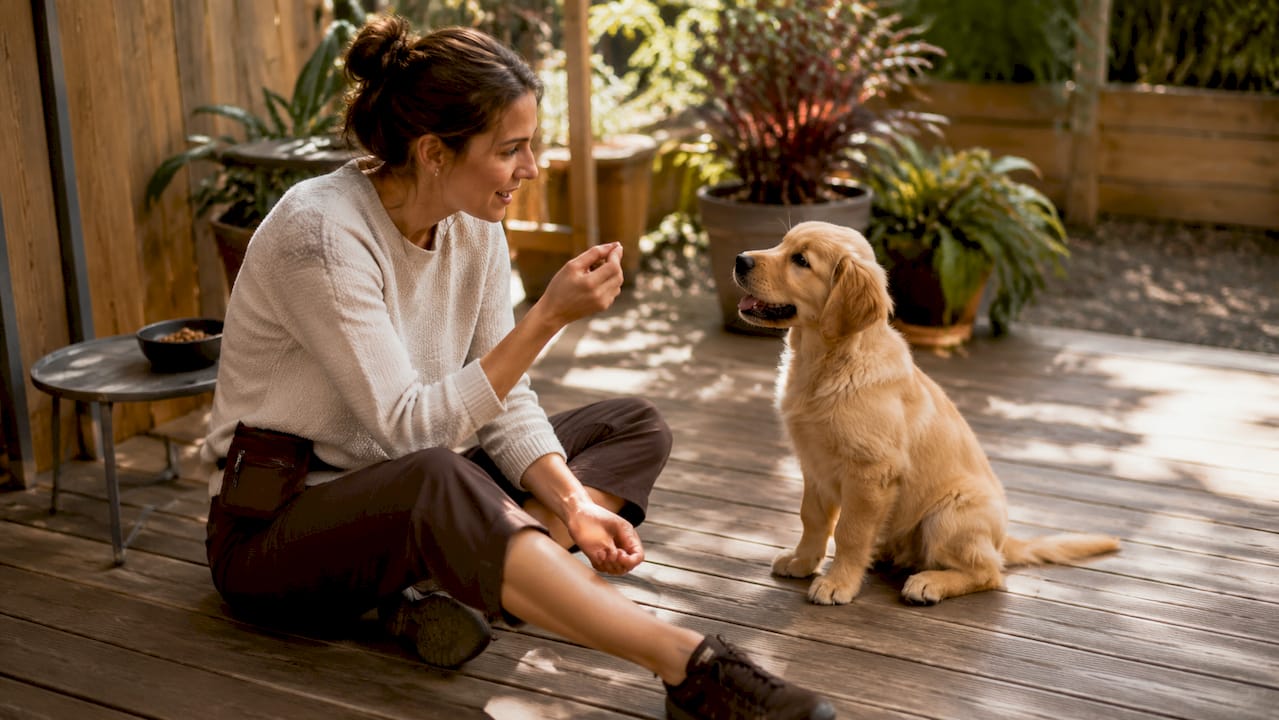
The training environment is the single most powerful variable determining whether your dog learns to obey reliably or only performs when conditions are perfect. Dogs are contextual learners who associate behaviours with their surroundings, not with abstract commands alone. This means the location, distractions, surfaces, and even your body posture during a session all become part of what your dog is actually learning. Understanding why training environment matters for dogs transforms how you approach every session, and it is the foundation of genuine, real-world obedience.
Why training environment matters dogs: the science of contextual learning
Dogs do not generalise commands the way humans generalise language. When your dog sits perfectly in your living room but ignores you at the park, that is not stubbornness. It is a predictable outcome of how canine brains process learning. B.F. Skinner’s operant conditioning framework, applied to dogs, shows that behaviours are reinforced within specific stimulus contexts. The command “sit” in your kitchen becomes a different signal to your dog than “sit” on a busy pavement, because the surrounding cues are entirely different.
This phenomenon is called discrimination learning. Your dog learns to discriminate between contexts, responding to the full picture of a situation rather than the verbal cue alone. The Service Dog Training Institute describes this as one of the most common reasons training fails in real-world settings. The renewal effect compounds this further: a behaviour extinguished in one location can reappear in a new one, and vice versa.
“Training environments are not mere backdrops but active rehearsal spaces that must replicate real-world conditions to build genuine competence.” — Healthcare Simulationists
Environmental overshadowing is equally important to understand. When a specific location dominates the learning context, the verbal cue becomes secondary. Your dog is essentially responding to “the kitchen” rather than to the word “sit.” Frequent variation in location and social context is the direct solution to this problem.
Dogs do not automatically transfer a learnt behaviour to a new setting without deliberate proofing.
Reliable obedience requires layering variables: new locations, new people, new distractions.
A cue is not truly generalised until your dog responds correctly in at least five distinct contexts.
The renewal effect means even well-trained behaviours can break down when the environment changes unexpectedly.
How do different environmental factors affect dog training outcomes?
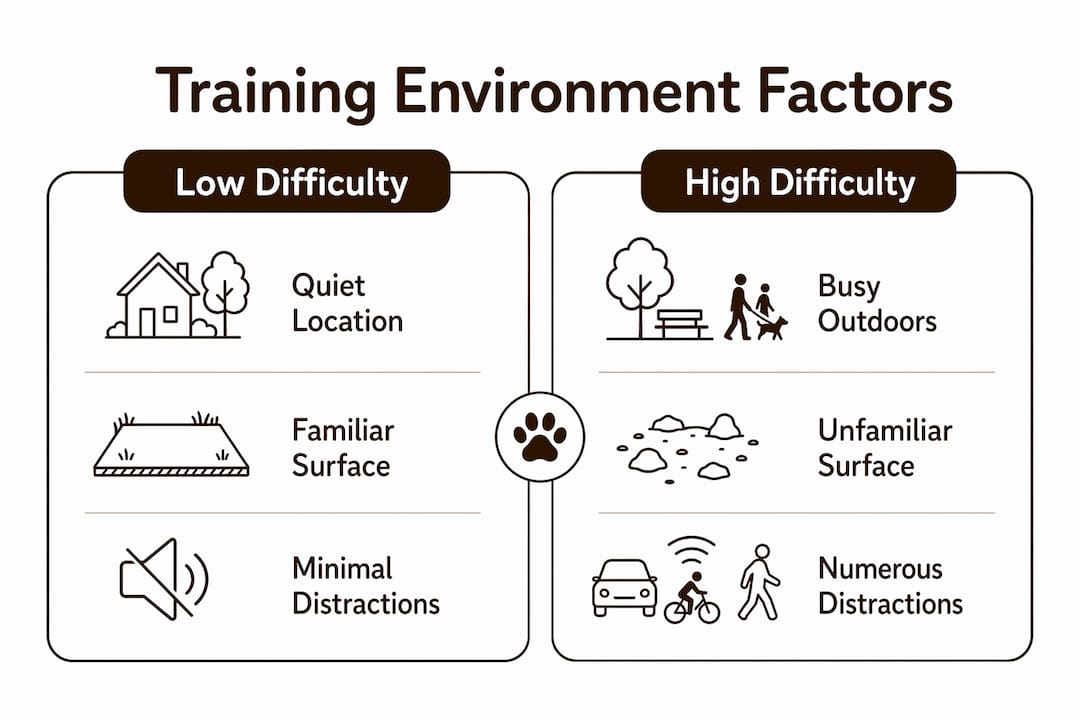
The dog training setup significance goes well beyond simply choosing indoors versus outdoors. Four main variables shape every session: location, distractions, surface, and handler behaviour.
Location and surface
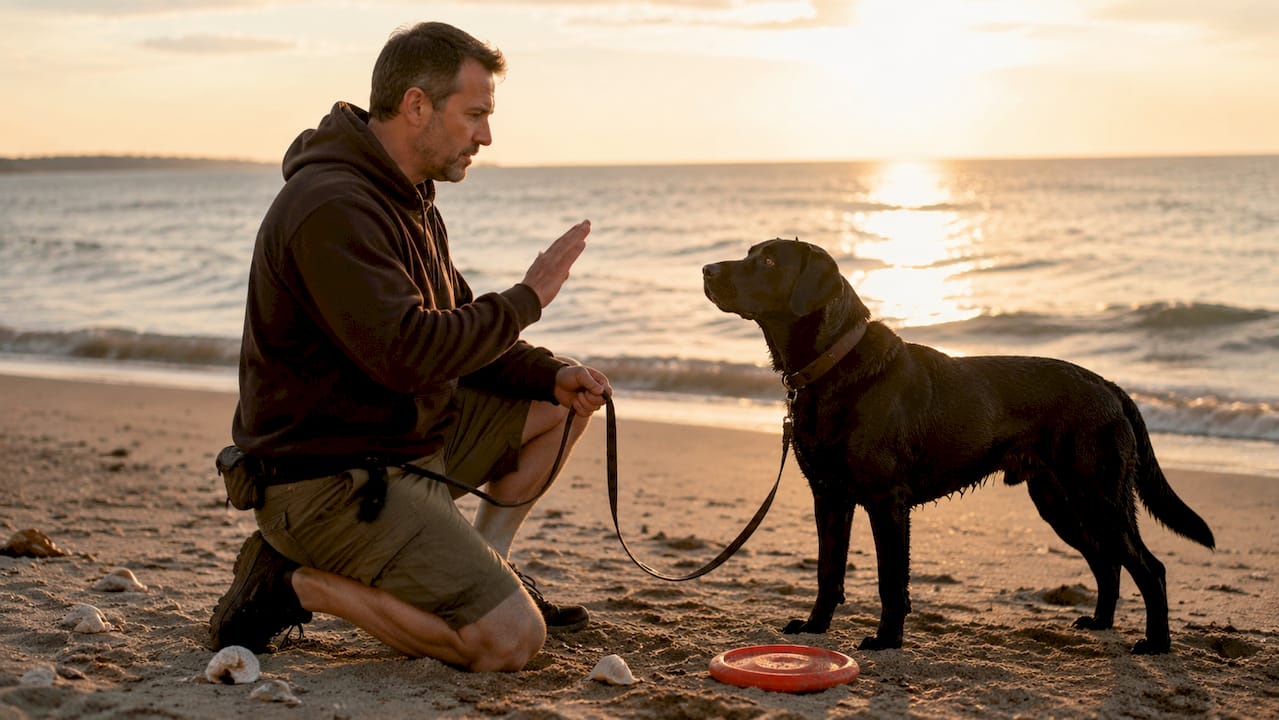
Different surfaces change how your dog moves and focuses. A dog trained exclusively on carpet may hesitate or refuse commands on slippery tiles or wet grass, not because of defiance but because the physical sensation is unfamiliar. Concrete, grass, gravel, and wooden decking each create a distinct sensory experience. Rotating surfaces during training builds physical confidence alongside behavioural reliability.
Environment factor | Low difficulty example | High difficulty example |
Location | Quiet home living room | Busy park with foot traffic |
Distractions | No other animals present | Other dogs playing nearby |
Surface | Familiar carpet or grass | Slippery tiles or wet concrete |
Handler behaviour | Familiar clothing, calm posture | Uniform, hat, or different body angle |
Distractions and handler variables
Distractions are not obstacles to training. They are training tools when introduced at the right level. People, other dogs, traffic sounds, and food smells all compete for your dog’s attention. The key is to introduce each distraction at a low intensity first, then gradually increase it as your dog’s reliability grows.
Handler variables are frequently overlooked. Research shows that posture, equipment, and clothing all affect how your dog reads you. A dog trained by an owner in casual clothes may not respond as readily to a stranger in a uniform. Varying your own appearance and position during training prevents your dog from keying in on irrelevant cues.
Pro Tip: When you move to a new training location, lower the difficulty of the task immediately. Ask for simpler behaviours your dog knows well, reward generously, and rebuild from there. This is not a step backwards. It is how generalisation actually works.
Why does early training and varied exposure build confidence in dogs?
The importance of training environment is amplified during puppyhood, when the brain is most receptive to new experiences. Puppies starting training before 12 weeks show significantly fewer fear, anxiety, aggression, and compulsive behaviours throughout their lives. This is not coincidence. Early exposure shapes the neural pathways that determine how a dog responds to novelty for the rest of its life.
The socialisation window between 8 and 16 weeks is the most critical period for confidence building. During this time, exposure to household sounds, people, and surfaces builds the neural associations that prevent neophobia, the fear of new things, from taking hold. A puppy that encounters traffic noise, children, and different floor textures during this window is far less likely to freeze or react fearfully to those same stimuli as an adult.
Here is what early, varied training achieves:
Fewer fear responses: Puppies exposed to varied environments early are less likely to develop anxiety around novel stimuli.
Better social skills: Regular contact with different people and dogs during the critical window builds appropriate social behaviour.
Stronger obedience foundations: Early obedience classes create habits of focus and responsiveness that carry through adulthood.
Reduced aggression risk: Structured early training correlates directly with lower rates of aggression and compulsive tendencies later in life.
Positive reinforcement during these early sessions is not just kind. It is neurologically effective. Reward-based training during the critical window creates positive emotional associations with learning itself, making your dog more willing to engage with new challenges throughout its life.
How to design training environments for reliable, real-world obedience
Practical environment design is where the science becomes something you can act on today. The goal is structured variability: deliberately varying the conditions of training so your dog builds resilience rather than environment-dependent habits. Training only in easy conditions creates behaviours that collapse the moment real life intervenes.
Follow this stepwise approach to proofing behaviours across environments:
Master the behaviour at home first. Practise in a quiet, familiar room until your dog responds correctly nine times out of ten. This is your baseline.
Change one variable at a time. Move to a different room, then to the garden, then to a quiet street. Each new location is a new context requiring its own proofing.
Introduce distractions gradually. Start with mild distractions, such as a toy on the floor, before progressing to other dogs or busy public spaces.
Keep sessions short and focused. Sessions of two to three minutes maintain cognitive focus and prevent your dog from becoming overwhelmed by competing stimuli.
Vary your own behaviour. Change your posture, clothing, and position relative to your dog. This prevents handler-dependent responses.
Proof across at least five distinct contexts. A cue is not truly generalised until your dog responds reliably across five or more different settings.
Reduce difficulty when entering a new environment. Never assume your dog will perform at the same level in a new place. Lower the bar, reward success, and build back up.
Managing arousal is equally important. A dog that is overstimulated cannot learn effectively. If your dog is barking, lunging, or unable to make eye contact, the environment is too challenging for that stage of training. Move further away from the distraction, reduce the complexity of the task, or end the session calmly and try again later.
Pro Tip: Use a marker training approach, such as a clicker or a consistent verbal marker like “yes,” to mark correct behaviours precisely at the moment they occur. In distracting environments, precise timing matters even more because your dog’s attention is divided.
The most successful training incorporates incremental exposure to increasing complexity rather than repetitive drills in a single location. Think of each new environment as a fresh rehearsal space, not a test. Your dog is not failing when it struggles in a new setting. It is simply telling you that more rehearsal in that context is needed.
Key takeaways
The training environment directly shapes a dog’s ability to generalise behaviours, meaning reliable obedience requires deliberate, varied practice across multiple real-world settings.
Point | Details |
Dogs are contextual learners | Behaviours are tied to specific environments and do not transfer automatically without proofing. |
Early training builds confidence | Starting before 12 weeks reduces fear, anxiety, and aggression throughout a dog’s life. |
Vary one factor at a time | Change location, distraction, or surface individually to build generalisation without overwhelming your dog. |
Short sessions maintain focus | Two to three minute sessions in new environments prevent cognitive overload and frustration. |
Five contexts confirm generalisation | A cue is only reliable once your dog responds correctly in at least five distinct settings. |
What I have learnt from watching dogs train in the wrong place
After working with hundreds of dog owners, the pattern I see most often is this: a dog that is brilliant at home and baffling in public. The owner is convinced their dog is being stubborn or deliberately disobedient. The dog is simply doing exactly what it was trained to do, in the only context it was trained to do it.
The uncomfortable truth is that most dogs are not undertrained. They are undertrained in variety. Owners put enormous effort into repetition in a single location and then feel let down when the behaviour does not hold up at the park or the vet. The science of context learning tells us this outcome is entirely predictable and entirely preventable.
What I encourage every owner to do is reframe new environments as opportunities rather than threats. When your dog struggles in a new place, that is useful information. It tells you exactly where the next round of training needs to happen. Patience here is not passive. It is a deliberate choice to layer complexity gradually rather than demand performance your dog has not yet been prepared for.
The owners who see the most consistent results are not those who train the hardest. They are those who train in the most places, with the most variety, and with the most willingness to lower the bar when the context changes. That combination of deliberate exposure and positive reinforcement is what turns a dog that obeys at home into a dog you can trust anywhere.
— Mark
Ready to train your dog in the right environment?
Understanding the dog training environment impact is one thing. Applying it consistently, across the right settings, with the right techniques, is where professional guidance makes a real difference.

Happy-dogtraining offers private obedience classes designed around your dog’s specific needs and real-world environment, using humane, science-based methods refined over 20 years of practice in Singapore. For dogs with more complex challenges, the AVS-approved intensive programme provides structured, environment-proofed training that builds genuine generalisation. Every programme includes free lifetime support, so you and your dog keep thriving long after the sessions end. Visit Happy-dogtraining to find the right fit for your dog.
FAQ
Why does my dog obey at home but not in public?
Your dog is a contextual learner, meaning it associates commands with the specific environment where they were taught. Without deliberate proofing across multiple locations, the behaviour simply does not transfer.
How many environments does my dog need to train in?
Research indicates a cue is not truly generalised until your dog responds reliably in at least five distinct contexts. Each new location, distraction level, or surface counts as a separate context requiring its own practice.
When should I start training my puppy in different environments?
The socialisation window between 8 and 16 weeks is the most critical period. Starting exposure early to varied sounds, surfaces, and people during this window builds confidence and reduces fear responses throughout life.
How long should training sessions be in a new environment?
Keep sessions to two to three minutes when working in a new or distracting setting. Short, focused sessions maintain your dog’s cognitive bandwidth and prevent the frustration that comes from asking too much too soon.
Is it normal for my dog to regress in a new training location?
Yes, and it is not regression. It is a predictable feature of contextual learning. Lower the difficulty of the task when you move to a new environment, reward generously, and rebuild from there. Your dog is not forgetting. It simply needs more rehearsal in that specific context.
Recommended
Comments