Behaviour modification plan for fearful dogs: your guide

An effective behaviour modification plan for a fearful dog combines four non-negotiable elements: a veterinary check to rule out pain or illness, daily management that keeps your dog below their fear threshold, gradual desensitisation and counterconditioning, and consistent positive reinforcement. Start here today:
Book a vet appointment to rule out pain, sensory loss, or illness.
Create a safe space your dog can retreat to at any time.
Identify your dog’s triggers and keep every interaction below threshold.
Begin short, calm, reward-based sessions of no more than five minutes.
A complete plan covers six areas: a structured assessment, measurable goals, a repeatable session template, daily management, progress monitoring, and a clear escalation path to a professional when needed.
Never use flooding or punishment-based methods with a fearful dog. Flooding — forcing prolonged exposure to a trigger — and aversive techniques such as shock collars or harsh corrections increase fear and significantly raise the risk of defensive aggression. These approaches are not shortcuts; they cause harm.
Table of Contents
How to assess your dog’s fear and set clear goals
Before any training begins, you need a clear picture of what you are working with. Guessing at triggers or jumping straight into exercises is one of the most common reasons progress stalls.
Building your assessment
Start with a veterinary examination. Pain, ear infections, vision loss, and thyroid conditions can all present as fearfulness, and no behaviour plan will work reliably until medical causes are ruled out. Once your dog has a clean bill of health, build a behaviour history: when did the fear start, did anything change around that time, and which specific situations trigger a response?
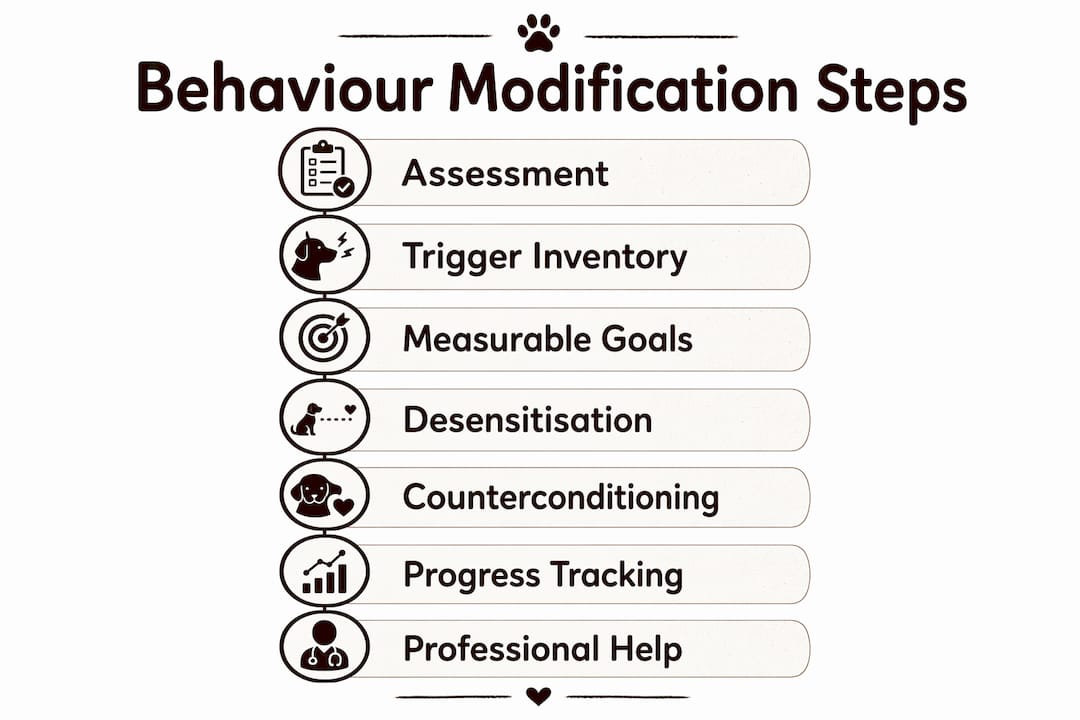
Next, create a trigger inventory. List every situation, sound, person, or animal that causes your dog to react, and note the approximate distance at which the reaction begins. That distance is your starting threshold. Body language signals to record include yawning, lip-licking, whale eye, a tucked tail, freezing, or attempts to flee.
Pro Tip: Film your dog in everyday situations using your smartphone. Video reveals subtle stress signals — a brief lip-lick, a weight shift backwards — that are easy to miss in the moment and invaluable when discussing your dog’s case with a behaviourist.
Writing measurable goals
Vague goals such as “be less scared of strangers” give you no way to judge progress. Instead, write goals in this format: “Dog remains relaxed at 5 metres from an unfamiliar adult in the garden for 60 seconds, achieving 4 out of 5 successful trials across two consecutive days.” That specificity tells you exactly when to progress to the next step and when to hold back. Clear, incremental goals also prevent the most common owner mistake: moving too fast because the dog “seemed fine.”
A practical, step-by-step behaviour modification plan
The sequence below is the backbone of evidence-based dog training for fearful dogs. Follow it in order; do not skip phases.
Assessment phase — complete the vet check, trigger inventory, and baseline behaviour log before touching any training exercises.
Foundation skills — teach calm, confidence-building behaviours: a relaxed mat cue, a hand-target, and simple sit/down sequences. These give your dog a predictable “job” and build trust without any exposure to triggers yet.
Desensitisation and counterconditioning — introduce triggers at sub-threshold distances, pairing each exposure with a high-value reward. Increase difficulty in small, measurable steps only when your dog is consistently relaxed.
Generalisation — practise in new locations, with different people, and at varied times of day so the new emotional response transfers beyond your training spot.
Maintenance — continue occasional low-level exposures and reward calm behaviour to prevent regression.
Session template
Duration: 3–5 minutes per session; fearful dogs fatigue quickly.
Frequency: Two to three sessions per day with at least a two-hour gap between them.
Reward type: Use the highest-value food your dog will accept — cooked chicken, cheese, or liver treats work well for most UK dogs. If your dog refuses food near a trigger, you are already over threshold; increase the distance.
Progression rule: Move to the next step only when your dog achieves a relaxed, willing response in 4 out of 5 trials across two separate sessions.
Regression rule: If your dog shows any stress signal, return immediately to the previous step. There is no shame in going back; it is how the plan works.
Pro Tip: Rotate two or three different high-value treats within a session to maintain engagement. A dog that has eaten six pieces of chicken in a row may stop responding — switching to cheese mid-session keeps motivation high without overfeeding.
How desensitisation and counterconditioning actually work
These two techniques are the core of any humane behaviour modification plan, and research consistently supports their use over punishment-based alternatives. Understanding the mechanics helps you apply them correctly.
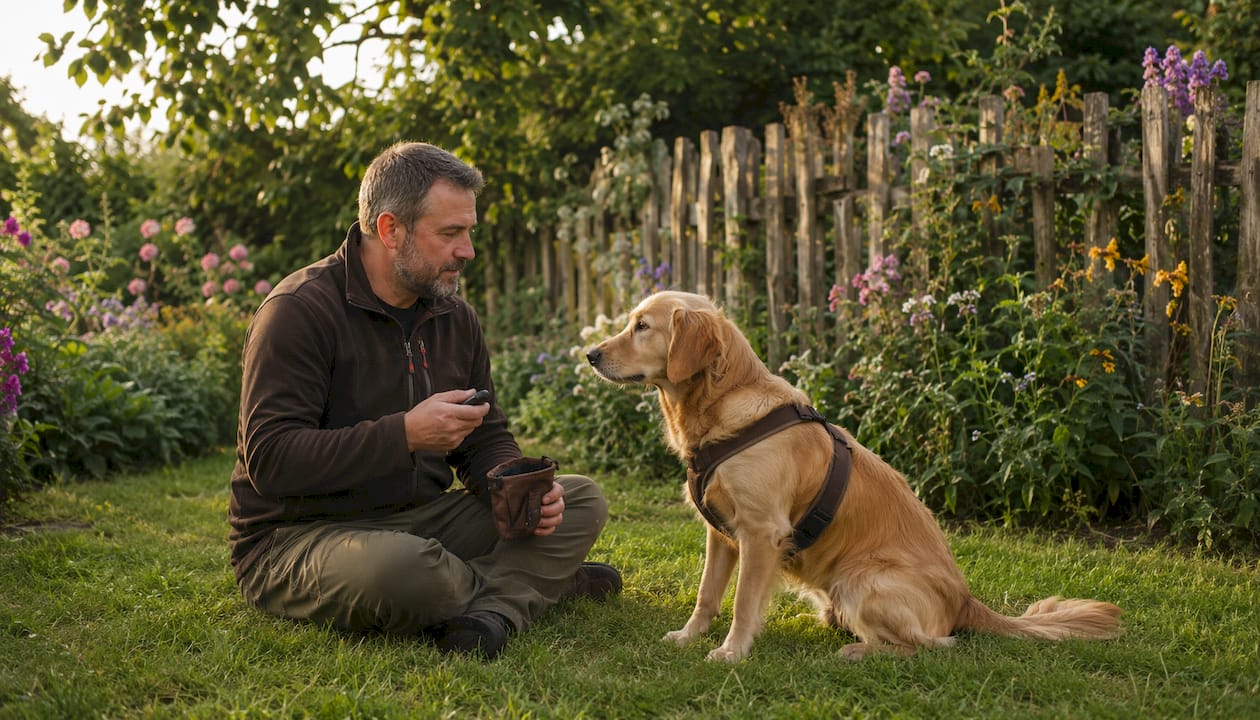
Desensitisation means exposing your dog to a trigger at such a low intensity that it produces no fear response at all. You are not asking the dog to cope with the scary thing; you are presenting it so faintly that it barely registers.
Counterconditioning means pairing that low-intensity trigger with something your dog genuinely loves, so the trigger begins to predict good things rather than threat. Over many repetitions, the emotional response shifts.
Practical examples
Strangers at the gate: Begin with a stranger standing 15 metres away, back turned, completely still. The moment your dog notices them, deliver a high-value treat. The stranger does nothing. Repeat until your dog looks at the stranger and immediately looks back at you for the treat. Only then reduce the distance by one metre.
Vacuum cleaner noise: Start with the vacuum in another room, switched off. Reward calm behaviour near it. Progress to switching it on briefly in the next room, then gradually bring it closer over many sessions.
Other dogs on walks: Begin at a distance where your dog notices the other dog but remains loose-bodied. Treat continuously while the other dog is visible; stop treating the moment it disappears. This is the “open bar / closed bar” method.
Dos and don’ts
Do mark the exact moment your dog notices the trigger (a clicker or a clear verbal marker such as “yes” works well) and deliver the treat within one to two seconds.
Do keep sessions short enough that your dog finishes relaxed, not exhausted.
Don’t allow the trigger to appear without a reward following. Consistency is what builds the new association.
Don’t force your dog to approach. Forcing interaction worsens fear and can provoke defensive aggression.
Don’t confuse desensitisation with flooding. Flooding means keeping the dog in the presence of the trigger until they stop reacting — it is not the same as calm, sub-threshold exposure, and it causes harm.
Pro Tip: Always end the session before your dog shows stress. A session that ends with a relaxed dog builds confidence; one that ends with a stressed dog teaches the dog that training is unpredictable. When in doubt, stop one repetition early.
Daily management: building a calmer, more predictable world
Management does not fix fear, but it creates the conditions in which training can work. A dog that is constantly pushed over threshold cannot learn new associations — their nervous system is simply too activated. Reducing daily stress is therefore not optional; it is part of the plan.
Core management measures
Safe space: Provide a crate, pen, or quiet room your dog can access at all times. Never use it as punishment. Cover three sides of a crate with a blanket to create a den-like feel.
Predictable routine: Set fixed times for meals, walks, and rest. Predictability reduces anxiety because your dog learns what comes next. A simple daily routine — morning walk, midday chew, evening training session — gives your dog a reliable map of the day.
Controlled greetings: Ask visitors to ignore your dog completely on arrival. No eye contact, no reaching out. Let your dog approach in their own time.
Learn-to-earn interactions: Ask for a simple behaviour (sit, touch) before giving attention, food, or access to the garden. This gives your dog a sense of control and reduces unpredictability.
Environmental tweaks
Use white noise or calming music to buffer sudden sounds indoors.
Fit visual barriers (frosted window film, garden screening) to reduce exposure to street triggers.
Plan walk routes to avoid known trigger hotspots, especially during early training phases.
Offer daily enrichment — sniff walks, scatter feeding, and lick mats — to reduce overall arousal through mental stimulation.
Pro Tip: Management is a bridge, not a destination. Using avoidance indefinitely prevents your dog from ever learning that triggers are safe. Keep management high during early training, then gradually reduce it as your dog’s confidence grows through the behaviour plan.
When veterinary assessment and medication can help
A veterinary examination is the first step in any behaviour modification plan, not an optional add-on. Conditions including chronic pain, hypothyroidism, and age-related sensory decline can all produce or worsen fearful behaviour. Treating the underlying condition sometimes produces a dramatic improvement in behaviour before any training begins.
When a dog’s baseline anxiety is very high, medication used alongside behaviour work can lower arousal enough for learning to occur. Commonly used options in UK veterinary practice include SSRIs such as fluoxetine, tricyclic antidepressants such as clomipramine, and situational medications such as trazodone or benzodiazepines for specific high-stress events. These are prescription-only medicines in the UK; your vet must assess and prescribe them.
Key pharmacological rules
Medications such as SSRIs and clomipramine take two to six weeks to reach therapeutic levels. Begin desensitisation work only once the medication is working, not before.
Never stop medication abruptly; taper under veterinary guidance to avoid withdrawal effects.
Medication reduces arousal so training can work — it does not replace the behaviour plan.
Monitor for side effects (sedation, appetite changes, gastrointestinal upset) and report them promptly to your vet.
Pro Tip: Ask your vet these four questions at the first appointment: How long before I should expect to see an effect? Will this medication interact with training? What side effects should I watch for? At what point would you consider tapering?
Owners managing the costs of long-term behaviour programmes may find it helpful to review practical ways to reduce pet care costs without compromising on the quality of veterinary or professional support.
When should you seek a professional behaviourist?
Some fearful dogs make steady progress with a well-structured home plan. Others need professional support from the start. Knowing when to escalate protects both your dog and your household.
Red flags that require professional help
Fear responses are worsening despite consistent management and training.
Your dog has snapped, growled, or bitten a person or animal.
You cannot safely feed, exercise, or handle your dog.
Your dog is injuring themselves (self-trauma, escape attempts).
Fear is generalising to situations that were previously fine.
Choosing a qualified professional in the UK
Look for practitioners registered with the Animal Behaviour and Training Council (ABTC), which is the UK’s regulatory body for animal trainers and behaviourists. For complex or severe cases, ask your vet for a referral to a Royal College of Veterinary Surgeons (RCVS) recognised specialist in veterinary behavioural medicine. Avoid any practitioner who uses or recommends aversive equipment or flooding.
Ask for a written treatment plan with measurable goals before committing to sessions.
Confirm they carry professional indemnity insurance.
Check that aftercare and follow-up support are included.
Pro Tip: Bring your behaviour log, smartphone videos, and your dog’s full medical history to the first consultation. A behaviourist who can see what you have already tried — and how your dog responded — can give you far more targeted advice in the first session.
How to measure progress and what timelines to expect
Progress in fearful dogs is rarely linear. Knowing what to measure, and what realistic timelines look like, prevents you from giving up too early or pushing too fast.
What to track
Metric | What to record | Why it matters |
Trigger distance | Closest distance dog remains relaxed | Shows desensitisation progress over time |
Fear response frequency | Number of fear responses per session | Downward trend confirms improvement |
Intensity score (1–5) | Severity of response at a given distance | Captures quality of change, not just distance |
Duration of calm | Seconds dog stays relaxed near trigger | Tracks counterconditioning depth |
Task success rate | Trials completed calmly / total trials | Guides progression decisions |
Realistic timelines
Mild cases with a single trigger and no trauma history often show measurable improvement within a few weeks of consistent work. Moderate cases typically require several months. Severe cases, or dogs with a history of trauma or prolonged fear, may need six months to a year or longer, and some will always need ongoing management. Individual variation is significant; genetics, early socialisation, and the duration of the fear all influence speed of change.
Objective monitoring using video logs consistently reveals more accurate progress than owner recall alone. Record a short clip at the start of each week in the same location with the same trigger at the same distance, and compare clips monthly.
Caution: Avoid rushing generalisation. Once your dog is relaxed with a trigger in your garden, it does not mean they are ready for the same trigger on a busy street. Introduce each new context as a fresh starting point, beginning at a greater distance than you think necessary.
Common owner mistakes that slow recovery
Even the most dedicated owners make predictable errors. Recognising them early saves weeks of lost progress.
Using punishment: Scolding, leash corrections, or startling a fearful dog suppresses visible fear signals without reducing the underlying emotion. The dog learns to hide their fear, which makes aggression more likely and progress harder to track.
Flooding: Keeping your dog in the presence of a trigger until they “get used to it” is not desensitisation. It is overwhelming and counterproductive, and it can permanently worsen fear.
Inconsistent rules: If some family members allow the dog to bolt from visitors while others practise controlled greetings, the dog receives conflicting information and cannot learn a reliable response.
Ignoring subtle signals: A lip-lick, a yawn, or a slight weight shift backwards are early stress signals. Missing them means the dog escalates to louder signals — growling or snapping — because the quiet ones were not heard.
Over-relying on avoidance: Management keeps the dog safe, but avoidance alone means the fear never reduces. Pair management with active training.
Handling setbacks as an owner
Your emotional state matters more than you might expect. Dogs read human tension quickly, and an anxious owner on a walk communicates that there is something to worry about. When a session goes wrong, take a breath, increase the distance from the trigger, and end on a calm, easy success — even if that just means asking for a sit and rewarding it generously.

Pro Tip: After a difficult session, write down what happened without judgement: the trigger, the distance, the dog’s response, and what you did next. Reviewing these notes a week later often reveals a pattern — a specific distance, time of day, or context — that you can adjust in the plan.
For practical guidance on getting back on track after a setback, the troubleshooting training setbacks resource from Happy-dogtraining walks you through common sticking points step by step.
What the research says about treating fearful dogs
The evidence base for desensitisation and counterconditioning is well established. Studies published in Applied Animal Behaviour Science and reviewed in veterinary behaviour manuals consistently show that reward-based, graduated exposure produces meaningful improvement in fearful dogs when applied correctly and consistently. Punishment-based approaches, by contrast, are associated with increased fear, increased aggression, and a breakdown in the human-dog relationship.
A 2024 MDPI review applying a trauma-informed care framework to anxious dogs argues that shifting the clinical question from “what is wrong with this dog?” to “what has this dog experienced?” produces better assessment and reduces the risk of re-traumatisation during treatment. This framing aligns closely with the approach that Happy-dogtraining uses: start where the dog is, not where you wish they were.
The neuroplasticity underlying behaviour change means that new emotional associations can form at any age, though the process takes longer in adult dogs with established fear histories. Welfare-first approaches that prioritise the dog’s emotional state over speed of results consistently produce more durable outcomes.
Reward-based methods are supported by peer-reviewed evidence and endorsed by the Merck Veterinary Manual, Cornell University College of Veterinary Medicine, and the RCVS.
Flooding is explicitly cautioned against in veterinary behaviour manuals as dangerous and likely to worsen fear.
Multi-modal approaches combining medication with behaviour modification show better outcomes for dogs with high baseline arousal than behaviour work alone.
Ethical, trauma-informed practice avoids re-traumatisation by respecting the dog’s communication and never forcing approach.
A copyable behaviour modification plan template
Use this template as a working document. Fill in each field, keep it visible, and bring it to every vet or behaviourist appointment.
Behaviour Modification Plan
Dog’s name and age:
Assessment summary (triggers, threshold distances, body language signs):
Medical status (vet check date, any conditions or medications):
Primary goal (specific, measurable, time-bound):
Secondary goals:
Session template: Duration / reward type / starting threshold distance / marker used
Progression criteria (e.g. 4/5 calm trials across two sessions):
Regression criteria (e.g. any stress signal = return to previous step):
Management measures in place:
Progress checkpoint dates:
Escalation plan (when to contact vet or behaviourist):
Example filled row: fear of strangers at the gate
Trigger: Unfamiliar adult approaching the garden gate.
Starting threshold: Stranger visible at 10 metres, standing still, back turned.
Step 1 goal: Dog remains loose-bodied and accepts treats for 30 seconds at 10 metres, 4/5 trials, two sessions.
Reward: Small pieces of cooked chicken, delivered via marker (“yes”) the moment the dog notices the stranger.
Progression: Reduce distance by one metre only when Step 1 goal is met.
Regression: Any stiffening, barking, or refusal of food = increase distance by two metres and restart.
Save this plan as a PDF, add short video links from your smartphone recordings, and share it with your vet or behaviourist before your first appointment. Keeping it updated weekly takes less than five minutes and makes professional consultations far more productive.
Key takeaways
A behaviour modification plan for a fearful dog works only when medical causes are ruled out first, the dog is kept below threshold throughout, and desensitisation is paired consistently with counterconditioning.
Point | Details |
Rule out medical causes first | A vet check before any training begins prevents wasted effort on a problem with a physical root. |
Keep below threshold always | A dog over threshold cannot form new associations; distance is your most important training tool. |
Pair exposure with reward | Counterconditioning changes the emotional response; desensitisation alone is not enough. |
Track progress objectively | Video logs and structured scoring reveal real change more reliably than memory alone. |
Happy-dogtraining’s approach | Happy-dogtraining combines humane, science-based methods with personalised plans and free lifetime support to help fearful dogs build lasting confidence. |
A word from experience
There is a tendency in dog training circles to treat fearfulness as a character flaw — something to be “fixed” or overcome through exposure and willpower. That framing does real damage. Fear is a protective emotion, and a dog that is afraid has usually learned, through experience, that the world is unpredictable or unsafe. The job of a good behaviour plan is not to override that learning through force; it is to replace it, slowly and kindly, with new evidence that the world can be trusted.
What I have seen consistently, working with fearful dogs over many years, is that the owners who make the most progress are not the ones who push hardest. They are the ones who learn to read their dog’s quiet signals, who celebrate a relaxed yawn near a trigger as a genuine win, and who understand that a session ending three repetitions early is not failure — it is skill. Setbacks are part of the process, not evidence that the plan is broken.
The research supports patience. Trauma-informed care, graduated exposure, and consistent positive reinforcement produce durable change. Punishment and flooding do not. That is not a matter of training philosophy; it is what the evidence shows. If your dog is struggling, the kindest and most effective thing you can do is slow down, reduce the difficulty, and keep showing up with good things to offer.
Happy-dogtraining can help your fearful dog
Fearful dogs need more than a generic training plan — they need a programme built around their specific triggers, their history, and their pace. Happy-dogtraining brings over 20 years of humane, science-based experience to exactly this kind of work, with personalised programmes that address fearfulness, reactivity, and confidence-building from the ground up.
Every programme includes a thorough behavioural assessment, a written plan with measurable goals, and free lifetime support after training completes — so you are never left wondering what to do when a new challenge appears. Whether your dog is mildly nervous around strangers or significantly reactive on walks, the approach is the same: kind, consistent, and grounded in what the evidence actually shows works.
Ready to take the next step? Visit Happy-dogtraining to find out how a personalised programme can help your dog build real, lasting confidence.
Useful sources and UK search terms
The following sources are worth bookmarking for clinical questions, professional directories, and further reading.
Cornell University College of Veterinary Medicine — Anxious Behaviour: Practical, vet-authored guidance on managing anxiety through routine, predictability, and behaviour modification. Excellent starting point for owners.
Merck Veterinary Manual — Behaviour Modification in Dogs: The clinical reference standard for desensitisation, counterconditioning, and the evidence against flooding and punishment.
MDPI — Trauma-Informed Care for Anxious Dogs: A peer-reviewed review applying trauma-informed principles to canine behaviour assessment and treatment; useful for understanding the welfare-first framework.
Applied Animal Behaviour Science: The primary peer-reviewed journal for canine behaviour research; search here for specific studies on fear and anxiety treatment outcomes.
PMC — Monitoring in Behaviour Modification: Practitioner guidance on objective monitoring tools including video logs and structured scoring.
Karen Overall — Protocol for Treating Fearful Behaviour: A detailed clinical protocol from one of the leading veterinary behaviourists; useful for owners working alongside a professional.
UK search terms for finding a qualified professional
ABTC registered behaviourist UK
RCVS recognised specialist veterinary behavioural medicine
veterinary behaviourist referral UK
CCAB certified clinical animal behaviourist
fear-free dog trainer UK
When searching for a professional, always verify credentials directly with the registering body. The ABTC maintains a public register at abtc.org.uk. For veterinary referrals, ask your GP vet to refer to an RCVS-recognised specialist rather than booking independently, as this ensures appropriate clinical oversight and, in many cases, is covered by pet insurance.
University veterinary schools — including those at Edinburgh, Bristol, Liverpool, and the Royal Veterinary College in London — also offer behaviour referral clinics staffed by specialists, which can be a more accessible route for complex cases.
Recommended
Comments