4–8 Week Loose Leash Training for Singapore Dogs with Force Free Steps
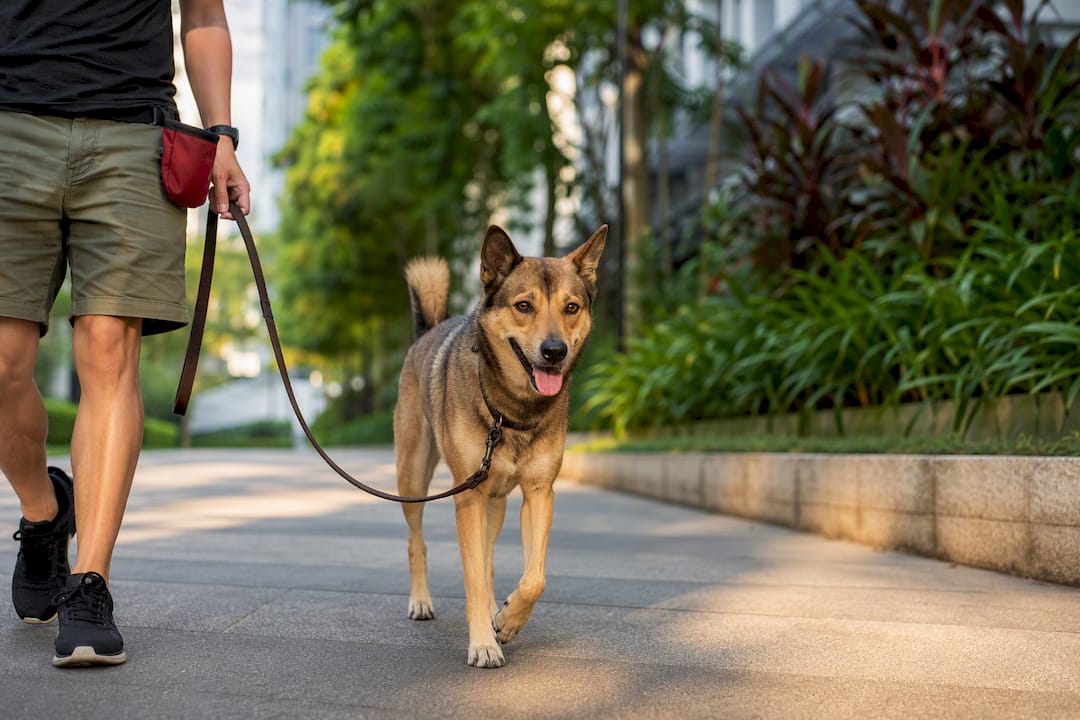
Yes, you can teach your dog to walk on a loose leash using force-free, reward-based training, and most dogs make real progress within four to eight weeks. The method rests on four pillars: a clear marker (a “yes” or clicker), rewards delivered at the right moment, a stop-and-wait cycle when the leash tightens, and gradual exposure to distractions. Your first step tonight is simple: grab some tasty treats, fit a well-adjusted harness, and practise a few loose leash walking steps indoors before you ever reach the front door.
TL;DR:
Most dogs need four to eight weeks of consistent, reward-based training to walk reliably on a loose leash, depending on individual factors.
Using a front-clip no-pull harness, paired with positive reinforcement and the stop-and-wait cycle, supports effective leash manners training.
Training begins indoors with short, frequent sessions focusing on marker timing and basic attention skills before progressing outdoors.
Gradually introduce distractions through threshold work and fade treats to maintain behavior in more complex environments.
Avoid aversive equipment like prong collars or choke chains, and regularly check harness fit and leash integrity for safety and progress.
Table of Contents
What is loose leash walking, exactly?
Loose leash walking means your dog moves alongside you with slack in the lead, never straining against the collar or harness to get somewhere faster. It doesn’t require a rigid heel position glued to your leg. Your dog can sniff, wander a little side to side, and explore, provided the leash stays soft in your hand rather than taut as a tightrope.
This distinction matters because plenty of owners confuse loose leash walking with formal obedience heeling, then feel like failures when their dog isn’t marching in lockstep. Leash manners training is about tension, not posture. If there’s slack in the leash, your dog is doing it right, even if they’re weaving to inspect a lamppost.
The payoff extends well beyond comfortable walks. Dogs who’ve learned not to pull tend to show lower stress on outings, because constant leash pressure against the throat or chest can heighten frustration and arousal. For you, it means fewer shoulder strains, fewer dropped leashes, and walks that actually feel like time together rather than a tug of war.
Which equipment actually supports leash manner training?
Gear choice can make or break your progress before you’ve even started teaching. A front-clip, no-pull harness is the standard recommendation for most dogs learning loose leash walking, because clipping the leash at the chest gently redirects a pulling dog back towards you rather than letting them drive forward with full body weight. Pair it with a flat leash of moderate length. Anything shorter limits your dog’s natural movement; anything longer makes consistent handling difficult.
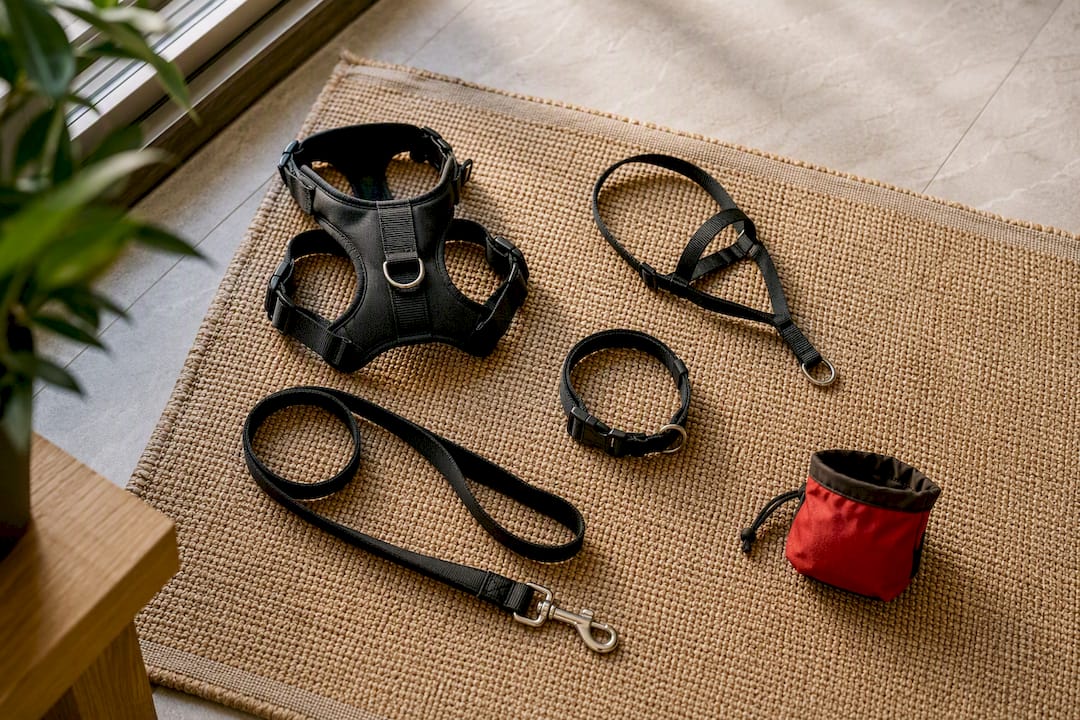
Head halters can help with strong, persistent pullers, particularly large breeds where a harness alone isn’t giving you enough steering control. They need a gradual, positive introduction, since dogs often resist anything touching their face at first. A flat collar is perfectly fine for dogs who are already light pullers or well along in their training, but it offers little mechanical advantage if your dog is still leaning hard into the lead.
Steer well clear of retractable leads, prong collars, choke chains, and electronic collars. Veterinary guidance is consistent on this point: aversive equipment carries real injury risk and can worsen the pulling behaviour it’s meant to fix, while retractable leads encourage constant tension rather than the slack you’re trying to build. Yanking the leash to correct pulling can cause tracheal damage and teaches your dog to associate walks with discomfort, not calm.
Before your first session, run through a quick fit check:
Two fingers should slide comfortably under any harness strap, no tighter.
The chest strap should sit above the elbow, not restricting shoulder movement.
No rubbing or chafing after a short test walk around the house.
Your dog can sit, lie down, and turn freely while wearing it.
Pro Tip: Let your dog wear a new harness or head halter around the house for a few short, treat-filled sessions before your first real walk. Rushing this step is the single most common reason dogs fuss with new gear outdoors.
Which skills does your dog need before leash work begins?
Loose leash walking doesn’t start on the leash. It starts with two skills that make every later stage faster: a reliable marker and a habit of checking in with you.
Teach the marker first. Say “yes” (or click) the instant your dog does something you like, then follow within a second or two with a treat. The marker’s job is precision. It tells your dog exactly which split-second of behaviour earned the reward, which is why trainers consistently recommend marking the exact moment before delivering it rather than praising vaguely after the fact. Our guide to how marker training works walks through the timing mechanics in more depth.
Build attention with check-in drills. In a quiet room, wait for your dog to glance at your face, mark it, and reward. Repeat until the glance becomes a habit rather than an accident. This “check-in” is the skill that will later pull your dog’s focus off a squirrel or a passing dog.
Practise a calm door routine. Ask for a sit before you open the door, clip the leash on without fuss, and only step outside once your dog is settled rather than straining at the threshold. A chaotic exit sets the tone for a chaotic walk, so this small ritual protects everything you’re about to practise outdoors.
Pro Tip: If your dog explodes with excitement the second they see the leash, practise picking it up and putting it straight back down, dozens of times across a few days, rewarding calm. Dogs learn fast that leash equals frantic energy; you can just as easily teach them that leash equals calm anticipation.
How long does it take to teach loose leash walking?
Most dogs need somewhere between four and eight weeks of consistent, short practice to walk reliably on a loose leash, and force-free protocols that reward calm walking over pulling typically follow that same timeframe. The exact number depends on your dog’s age, energy, and history of rehearsed pulling, but the structure below gives you a realistic week-by-week map.
Week 0 to 1: build the foundation indoors
Start inside, in a hallway or living room, with zero outdoor distractions competing for attention.
Hold a treat at your side and lure your dog into position beside your leg, marking and rewarding for a single step.
Gradually stretch this to three, then five, then ten steps before delivering the reward, always marking the exact moment your dog is in position.
Attach the leash but don’t leave the house yet. Practise the same luring and marking with the leash clipped on and trailing loosely, so your dog gets used to the sensation of wearing it while learning.
Keep sessions to five or ten minutes, multiple short sessions daily. Short, frequent drills with frequent reinforcement in the early stages build the skill far more reliably than one long, exhausting session.
Our guide to why dogs perform better at home explains why this indoor-first approach speeds up everything that follows.
Week 1 to 4: red light, green light in the real world
Once your dog is reliably walking beside you indoors, move to your garden or a quiet street and introduce the core walking cycle.
The method is simple, and it’s the backbone of most successful loose leash walking protocols: the moment the leash goes tight, you stop dead and become a statue. Wait. The second your dog turns back or the leash slackens, mark, reward, and resume walking. This wait-for-slack, then-reward, then-continue cycle is widely recommended precisely because it removes any reward for pulling while making the return to you the only thing that gets the walk moving again.
There’s a subtle trap here worth avoiding. If you reward the instant your dog returns to your side and then stop walking, you risk teaching a “pull, return, treat” sequence rather than genuine loose leash walking. Walking a few more steps together after your dog returns, before delivering the treat, breaks that unwanted pattern and rewards sustained calm walking instead.
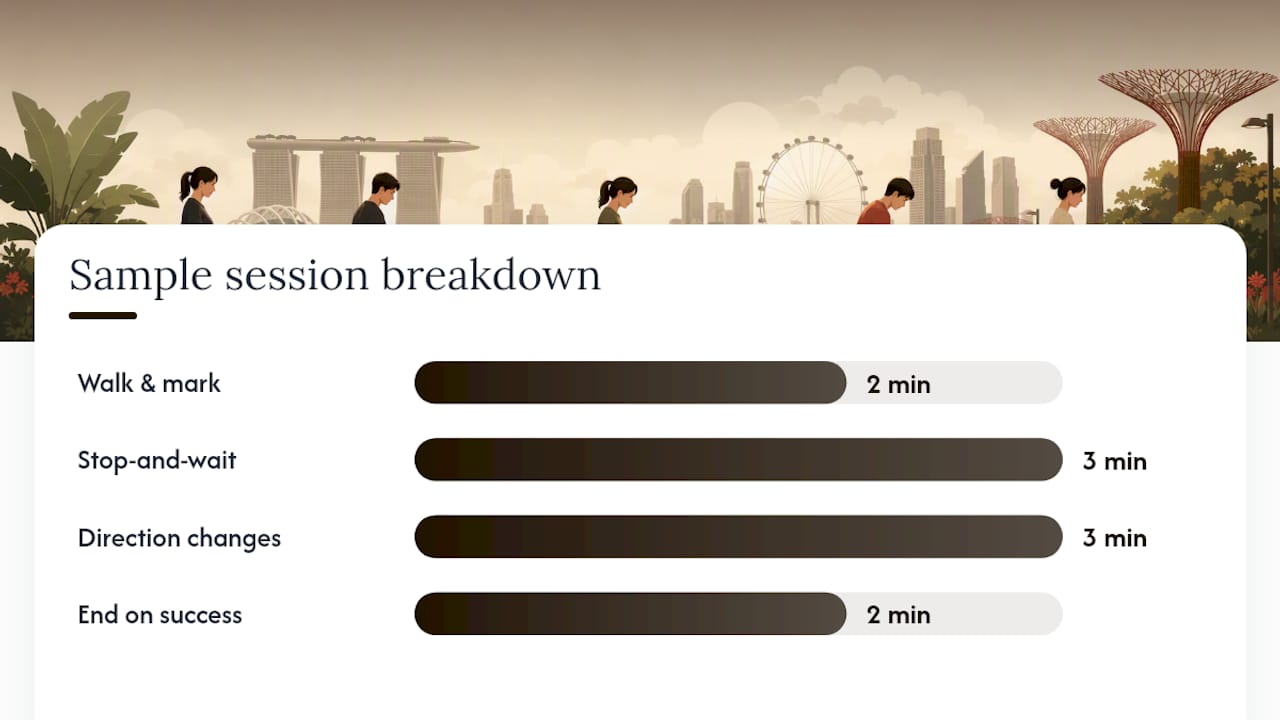
A sample session template for this stage:
Minute 0 to 2: Walk five to ten steps in a quiet area, marking loose leash moments every few steps.
Minute 2 to 5: Introduce the stop-and-wait cycle whenever tension appears; reward generously on return.
Minute 5 to 8: Add gentle direction changes (turning away from mild distractions) to keep your dog engaged with you rather than the environment.
Minute 8 to 10: End on a success, even a small one, and head home or take a play break.
Run two or three of these sessions daily rather than one marathon walk. Fatigue and frustration undo far more progress than short breaks between sessions ever will.
Week 3 to 8: threshold work and fading treats
This is where loose leash walking either sticks or falls apart, because it’s where real-world distractions enter the picture. Starting in low-distraction settings and only gradually raising the difficulty is standard professional guidance, and it applies just as much to distraction training as it did to your first indoor sessions.
Threshold work means finding the distance at which your dog notices a distraction (another dog, a jogger, a squirrel) but can still respond to your marker and stay under control. That might be thirty metres for a reactive dog or three metres for a laid-back one. Practise there first, rewarding calm attention, and only close the distance once your dog is succeeding consistently, not occasionally.
A practical progression:
Identify three or four common distractions on your usual routes.
Practise loose leash walking at a distance where your dog can still succeed at least eight or nine times out of ten.
Reduce the distance by small increments only after several consecutive successful sessions.
Introduce movement (a passing cyclist, a jogging stranger) before introducing proximity, since moving distractions are often harder.
Once your dog is walking loosely past moderate distractions most of the time, start fading the treats. Move from rewarding every single step of loose walking to rewarding every second or third instance, then to a genuinely variable schedule where your dog can’t predict when the treat is coming. Variable reinforcement is what keeps a trained behaviour durable long after the constant treat stream stops, much like a fruit machine keeps players pulling the lever on an unpredictable payout. Real-world rewards, a sniff break, a chance to greet a friendly dog, a game with a toy, can gradually take over from food as the main motivation.
A sample daily template you can copy
Time slot | Focus | Duration |
Morning | Marker refresh, check-in drills | 5 minutes |
Midday or after work | Loose leash practice on regular route, stop-and-reward cycle | 8 to 10 minutes |
Evening | Threshold work near one chosen distraction | 5 to 8 minutes |
Consistency across these short sessions beats one long, frustrating walk every time.
Why does my dog keep pulling despite training?
Pulling persists because it’s been rewarded, often for months or years before you started training. Every time your dog pulled and successfully reached the tree, the other dog, or the doorway faster, that pulling was reinforced. Undoing that history means making loose leash walking consistently more rewarding than pulling, which takes patience precisely because the old habit had such a long head start.
A few common stalling points and fixes:
The eager puller who ignores treats outdoors. Increase distance from distractions and switch to higher-value rewards, small pieces of chicken or cheese rather than dry kibble, which often can’t compete with the excitement of the outside world.
The scent-driven dog who beelines for every smell. Build in scheduled sniff breaks as a reward for loose walking, rather than fighting the nose constantly. Cue a release word, let them sniff freely for thirty seconds, then resume.
The dog who freezes or spins instead of pulling. This often signals the environment is too much too soon. Increase distance from triggers and slow the whole protocol down rather than pushing through.
Slow or stalled progress after weeks of practice. Extend the protocol. Some dogs, especially those with years of rehearsed pulling, genuinely need longer than eight weeks, and that’s normal rather than a sign of failure.
Pro Tip: Film one of your own walks. Handler habits, letting the leash go slack inconsistently, stopping only sometimes when it tightens, are often invisible to the person holding the leash but obvious on video, and fixing your own mechanics can unstick a training plateau faster than any new technique.
If pulling is accompanied by lunging, growling, or apparent panic around specific triggers, this usually points to fear or reactivity rather than simple excitement. Veterinary guidance recommends professional behavioural assessment in these cases rather than forceful correction, since punishment tends to deepen fear-based reactions rather than resolve them. A sudden change in pulling behaviour, especially in an older dog, is also worth a veterinary check to rule out pain or discomfort as the underlying cause.
How do you take loose leash walking from the driveway to real life?
Skills learned in your garden or a quiet street don’t automatically transfer to a busy park on a Saturday morning. Proofing means deliberately practising in a widening range of environments: your street, a quieter park, a busier park, past cafés with outdoor seating, near school pickup times. Each new environment resets the difficulty slightly, so treat the first session in any new setting as a step back to easier distances.
Practical ways to keep generalising without burning out:
Rotate two or three walking routes so your dog doesn’t just learn the pattern of one street.
Use variable reinforcement once behaviour is solid in a setting, occasional treats, occasional praise, occasional sniff breaks, so the habit doesn’t collapse the moment treats stop appearing.
Fit training into existing routines rather than carving out separate time. The walk to the letterbox, the school run, the coffee run, each becomes a mini training session if you carry a few treats.
Watch for regression around new distractions like cyclists, prams, or other dogs, and simply increase distance again rather than assuming the training has failed.
Our piece on dog independence training covers the broader skill of weaning a dog off constant food rewards, which pairs naturally with this generalising stage.
What safety and welfare checks matter most?
Prong collars, choke chains, and electronic collars carry a documented risk of physical injury and can create lasting negative associations with walking itself, a concern veterinary sources raise consistently. Retractable leads compound the problem because they never let a dog experience genuine slack, undermining the very behaviour you’re trying to teach.
Watch for pulling that starts suddenly in a previously calm dog. That pattern often signals pain, vision or hearing changes, or an emerging anxiety rather than a training gap, and deserves a veterinary or behavioural assessment before you assume more repetitions will fix it.
Before every walk, run this quick check:
Harness or collar fits snugly with no rubbing.
Leash and clips show no fraying or weak points.
You know your local rules on off-leash areas and required restraint in public spaces.
You’re supervising closely near roads, cyclists, and other dogs, since even well-trained dogs can be startled.
How Happy-dogtraining applies this protocol in real sessions
The loose leash walking and broader obedience skills described above reflect a force-free, reward-based approach carried out with humane training methods. In practice, that means short, focused intervals rather than long drilling sessions, precise marker timing from the trainer to catch the exact moment a dog earns a reward, and a pace that matches each individual dog’s temperament rather than a one-size-fits-all script.
Inside a structured programme, owners may see clear, tailored session plans, hands-on coaching on marker timing and leash handling mechanics, and guidance that adapts to different dogs’ breed, age, and energy level.
A trainer’s honest take on what actually works
Most loose leash walking advice online focuses obsessively on technique: the perfect harness, the perfect stop-and-wait cycle, the perfect treat. What gets underplayed is handler consistency. Dogs don’t fail at loose leash walking nearly as often as owners fail to apply the same rule every single time the leash goes tight. One inconsistent walk, where you let pulling work because you’re in a rush, can undo several good sessions.
Here’s a daily checklist worth pinning to your fridge:
Treats in your pocket before the leash comes out.
Two or three five-minute sessions rather than one long walk.
Stop the second the leash tightens. Every time, not most times.
Mark and reward the return to slack, then take a few more steps before delivering the treat.
Expect plateaus. Expect a great week followed by a wobbly one. That’s normal, not failure. Dogs who’ve rehearsed pulling for years simply need longer, and rushing the timeline tends to backfire more than it helps.
— Mark
Ready for hands-on help with loose leash walking?
Professional loose leash walking training offers structured intensives designed around each dog’s temperament, with certified trainers providing real-time correction of handling mechanics.

Such programmes typically include tailored training plans considering a dog’s breed, age, and temperament, direct coaching on marker timing and leash mechanics, and ongoing support after completion to assist owners with new questions. If your walks still feel more like a wrestling match than a stroll, book a place on the 4-week AVS-approved intensive programme or visit the Happy-dogtraining homepage to ask about the right fit for your dog.
Sources
Recommended
Comments