Why dogs bite without warning: what owners must know
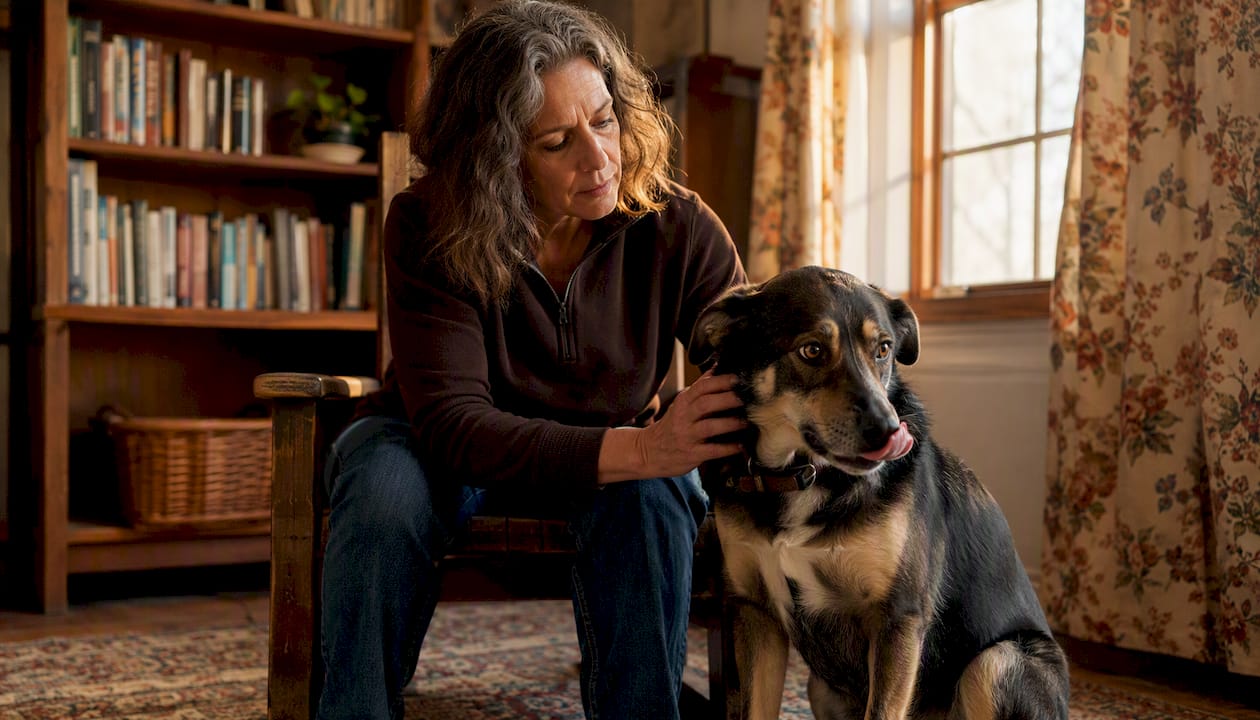
Most dogs don’t bite out of nowhere. Bites are rarely random — they are almost always defensive responses that follow a sequence of signals people either miss or misread. When a bite feels sudden, it usually means the earlier warnings went unnoticed, not that they weren’t there.
If a bite has just happened, here is what to do right now:
Separate safely. Move people and other animals away from the dog calmly. Avoid shouting or sudden movements, which can escalate things further.
Check for injury. Assess the wound carefully. Dog bites can look minor but carry a real risk of infection, so take any break in the skin seriously.
Preserve evidence. If it is safe to do so, photograph the injury and the scene, and note down exactly what happened, including what the dog was doing beforehand.
Seek medical help if needed. For any wound that breaks the skin, contact your GP or NHS 111. For serious injuries, go to A&E.
Book a veterinary check as a priority. If the biting behaviour was sudden or out of character, a medical cause needs to be ruled out before anything else.
Table of Contents
Why dogs bite without warning: the ladder of aggression explained
What actually triggers a bite? Behavioural causes owners often overlook
Could a medical problem be causing your dog to bite suddenly?
Why bites look unpredictable: the human and situational blind spots
Practical prevention: what you can do at home starting today
If a bite happens: first aid, documenting the incident and UK next steps
Can your dog be trusted again? Weighing rehabilitation, rehoming and other options
Trainer insight from Happy-dogtraining: what we see and what actually helps
Do breed and individual temperament affect bite risk and warning signals?
Environmental stressors that can push a dog to bite without obvious warning
Why dogs bite without warning: the ladder of aggression explained
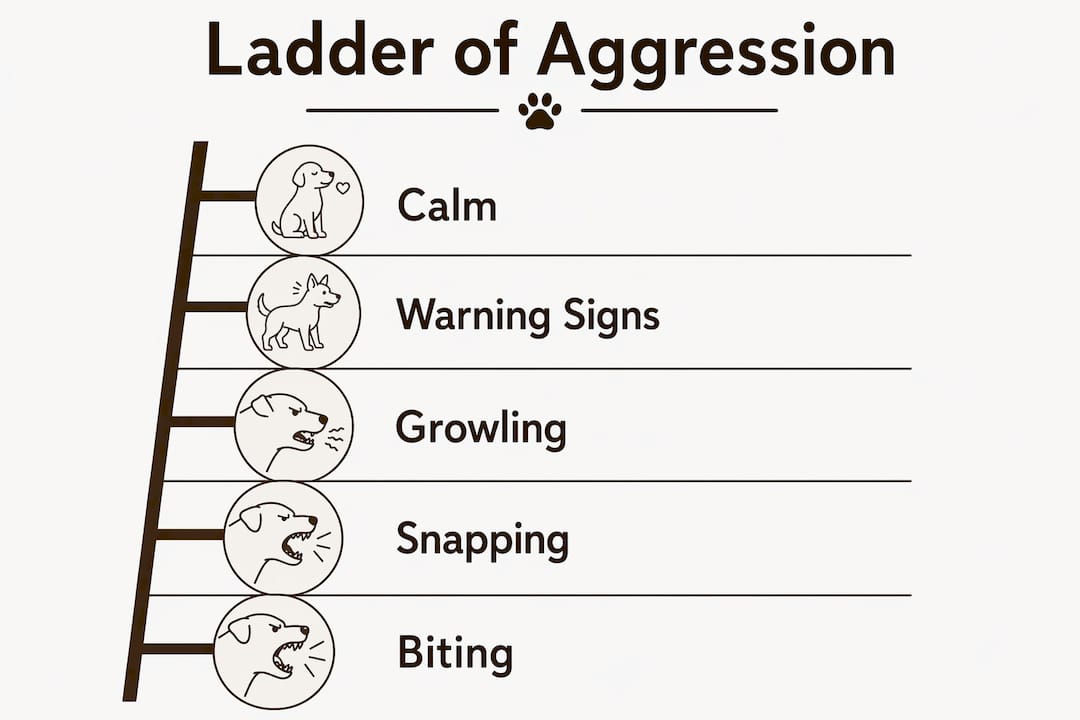
The phrase “without warning” is one of the most common things owners say after a bite, and it is almost always inaccurate. Dogs communicate constantly through body language, and the ladder of aggression describes how they escalate from subtle calming signals all the way to a bite when earlier signals are ignored.
The ladder works like this: a dog begins with calming signals (yawning, turning away, lip-licking), moves to avoidance (moving away, lowering the head), then to more visible tension (stiffening, freezing, whale eye), then to growling or snapping, and finally to a bite. Most owners only notice the growl or snap, which feels sudden. In reality, the dog has been communicating for some time.
The signals owners most commonly miss include:
Lip-licking when there is no food present
Yawning in a tense or busy situation
Whale eye (the whites of the eyes visible at the corners)
Freezing mid-movement, especially during handling
Stiffening of the body or tail
Shifting weight away from a person or stimulus
Turning the head or body away from an approaching person
A child leaning over a dog resting on the sofa is a classic scenario. The dog may yawn, look away, and stiffen, all of which the child (and nearby adults) interpret as the dog being relaxed. The dog is doing the opposite: it is asking for space. When that request is ignored, escalation follows.
Pro Tip: In child-dog interactions, watch the dog’s face and body rather than the child’s behaviour. If you see lip-licking, yawning, or the dog turning its head away, calmly redirect the child before the dog feels it has no other option. Never wait for a growl to act.
What actually triggers a bite? Behavioural causes owners often overlook
Aggression is almost always rooted in fear or the perception of a threat. Understanding the specific trigger makes prevention far more achievable.
Fear-based responses are the most common cause. A dog that feels cornered, overwhelmed, or unable to escape will bite to create distance. This is why bites during grooming, veterinary handling, or being picked up are so frequent. The dog is not being aggressive in the way people imagine; it is frightened and out of options.
Resource guarding is another trigger that surprises owners. A dog that guards food, toys, a bed, or even a favourite person may bite when those resources feel threatened. The guarding can be subtle: a slight stiffening over the food bowl, a hard stare when someone approaches the sofa. Many owners miss these early signals entirely.
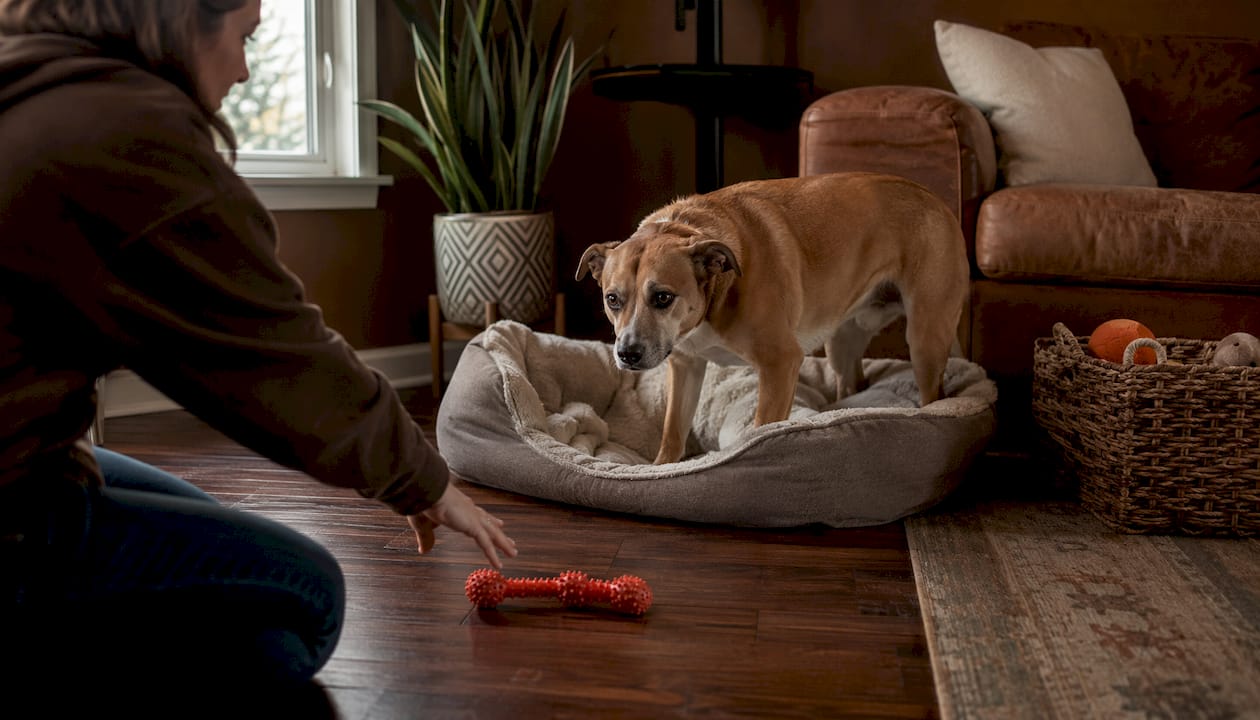
Startle responses are particularly common in older dogs or those with sensory loss. A dog woken suddenly from sleep may bite before it is fully aware of what is happening. The bite can genuinely surprise the dog as much as the person.
Redirected aggression happens when a dog is aroused or frustrated by one stimulus (another dog outside the window, for example) and bites the nearest person instead. This is not targeted aggression toward that person; it is overflow from an already overwhelmed state.
A few common myths worth addressing:
“It’s a dominance issue.” Dominance theory has been largely discredited as an explanation for most household biting. The real driver is almost always threat perception, fear, or pain.
“He’s never done it before, so it came from nowhere.” A first bite rarely is a first warning. It is usually the first time the dog’s earlier signals were pushed past the point of tolerance.
“He was wagging his tail.” A wagging tail signals arousal, not necessarily friendliness. Context matters far more than a single signal.
Scenarios where signals are particularly easy to miss include a dog on someone’s lap during television (any sudden movement can trigger a startle bite), a dog being groomed around the face or ears, and a dog approached while sleeping in a quiet corner of the house.
Could a medical problem be causing your dog to bite suddenly?
A sudden change in a dog’s behaviour, especially biting that feels out of character, should prompt a veterinary appointment before any behaviour programme begins. Medical issues including pain, dental disease, arthritis, and hormonal problems can lower a dog’s tolerance and produce defensive bites with very little provocation.
Common medical causes to rule out include:
Dental pain (often invisible to owners but significant for the dog)
Osteoarthritis or musculoskeletal pain, particularly in older dogs
Neurological conditions affecting impulse control or sensory processing
Endocrine disorders such as hypothyroidism
Occult infections causing discomfort or fever
Sensory loss (reduced hearing or vision, especially in senior dogs)
When you go to the vet, bring as much detail as possible. A clear picture helps enormously.
What to bring to your veterinary appointment:
A written timeline of incidents, including dates, times, and what was happening immediately before each bite
Video footage of the behaviour if you have captured it safely
Notes on any changes in appetite, sleep, mobility, or general demeanour
A full list of current medications and supplements
Details of any recent changes at home (new people, new pets, house moves, routine changes)
Pro Tip: Keep a simple behaviour log on your phone. Note the date, what triggered the incident, and how the dog responded. Even a week’s worth of entries gives your vet and behaviourist a much clearer picture than memory alone.
Why bites look unpredictable: the human and situational blind spots
One of the most important concepts in understanding dog aggression is the bite threshold model. Think of it as a bucket filling with water. Each stressor adds a little more: a noisy morning, a stranger at the door, a child pulling at the dog’s ear, a missed walk. Individually, none of these would cause a bite. Together, they push the dog over its individual threshold. The final trigger, which might be something as minor as a hand reaching toward the dog, looks like the cause. It is really just the last drop.
Punishing growling is one of the most significant ways owners inadvertently make bites more likely. Growling is communication. When a dog learns that growling results in punishment, it stops growling and goes straight to a bite. The warning system has been removed, not the underlying discomfort.
Confinement and lead restraint are also common situational contributors. A dog on a lead cannot move away from something frightening, so it may bite instead. A dog behind a gate or in a crate that feels cornered may escalate faster than the same dog in an open space.
For households with children or regular visitors, a few safety principles apply consistently: never leave young children alone with any dog, teach children to read basic body language, and give the dog a safe space it can retreat to without being followed. If the dog goes to its bed or crate, that space should always be respected.
Practical prevention: what you can do at home starting today
Prevention is built on two foundations: management (arranging the environment so the dog cannot be pushed into a bite situation) and training (changing how the dog feels about the triggers that worry it).
Management strategies
Create a safe space: a crate, bed, or room the dog can access freely and that children and visitors are taught to leave alone.
Use baby gates to separate the dog during high-risk moments (mealtimes, visitors arriving, noisy events).
Keep the dog on a well-fitted harness and lead in public; a secure garden with no gaps is non-negotiable for dogs with high prey drive.
Supervise all interactions between the dog and children, and intervene at the first calming signal, not the first growl.
Training principles
Reward-based desensitisation and counterconditioning are the gold standard for reducing fear and resource guarding. The goal is to change how the dog feels about the trigger, not just to suppress the behaviour. For resource guarding, this means teaching the dog that a person approaching its bowl predicts something good, rather than a threat.
Do | Don’t |
Teach a reliable “leave it” or “off” cue using rewards | Physically force the dog away from a resource |
Let the dog move away from interactions it finds uncomfortable | Corner or restrain a dog that is showing calming signals |
Reward calm behaviour around triggers | Punish growling or other warning signals |
Introduce a muzzle gradually using positive association | Put a muzzle on a dog without prior training |
Use a safe space the dog can access freely | Follow the dog into its retreat space |
Muzzle training is worth doing proactively, not just in a crisis. A basket muzzle introduced gradually with treats and patience allows the dog to pant, drink, and take food, and gives you a safe option for veterinary visits or high-risk situations. Reward-based training tailored to your dog’s temperament will always produce more durable results than suppression-based methods.
Pro Tip: Never remove a dog’s ability to warn. If your dog growls during grooming or handling, stop what you are doing, give the dog space, and seek guidance from an accredited behaviourist. The growl is information, not defiance.
If a bite happens: first aid, documenting the incident and UK next steps
A calm, methodical response in the immediate aftermath protects everyone and gives you the best foundation for what comes next.
Separate safely. Do not grab or shout at the dog. Use a calm voice, a treat, or a barrier to create distance. Secure the dog in another room or on a lead.
Assess the injury. Check the wound carefully. Dog bites can appear small but puncture deeply.
Administer basic first aid. Wash the wound thoroughly with soap and running water for at least five minutes. Apply a clean dressing.
Seek medical attention. Contact NHS 111 or your GP for any wound that breaks the skin. Go to A&E for deep punctures, wounds that won’t stop bleeding, or bites to the face, hands, or joints. Dog bites carry a risk of infection, including from Pasteurella bacteria and, in rare cases, rabies in dogs recently imported from abroad.
Document the incident. Photograph the injury and the scene. Write down exactly what happened: what the dog was doing beforehand, who was present, what triggered the bite, and the time and date. Collect contact details from any witnesses.
Report if required. If the bite was from a dog you do not own, or if it occurred in a public place, you may wish to report it to your local council or the police. Under the Dangerous Dogs Act 1991, it is a criminal offence for a dog to be dangerously out of control in any place.
Contact your vet. Even if the bite was from your own dog, call your vet to discuss next steps and whether a behaviour referral is appropriate.
The RSPCA and PDSA both offer behaviour guidance online, and the NHS provides up-to-date first aid advice for bite wounds.
Can your dog be trusted again? Weighing rehabilitation, rehoming and other options
A bite does not automatically mean a dog cannot recover. Many dogs that have bitten go on to live safely with their families after proper assessment and a structured behaviour programme. The key is honest evaluation.
Factors that influence the prognosis include:
Severity and context of the bite. A single bite during a high-stress, one-off event carries a different prognosis than repeated bites with escalating severity.
Medical causes. If a medical issue was responsible and has been treated, the prognosis is often very good.
History of incidents. A dog with a long history of escalating aggression requires more intensive support.
Household composition. The presence of young children, elderly people, or individuals with disabilities raises the stakes for risk management.
Access to professional support. Rehabilitation is possible with the right help, but it requires commitment, consistency, and often specialist input.
Decision factors to consider:
Can you realistically manage the triggers in your home environment?
Is every household member willing and able to follow a consistent management plan?
Do you have access to a clinical animal behaviourist and veterinary support?
Is the dog’s quality of life acceptable during rehabilitation?
Pro Tip: Before making any decision about rehoming or euthanasia, seek a second opinion from a clinical animal behaviourist. A single incident, especially one with a clear medical or situational cause, rarely justifies an irreversible decision. Get the full picture first.
Who should you contact? Vet, behaviourist or trainer
Knowing who to call, and when, saves time and gets your dog the right help faster.
See a vet first if:
The biting behaviour is new, sudden, or out of character
The dog shows any signs of pain, stiffness, or changes in appetite or energy
You suspect a medical cause
Book a clinical animal behaviourist if:
The behaviour has a clear emotional or learning history (fear, guarding, anxiety)
The vet has ruled out medical causes
The biting is recurring or escalating
Work with a qualified trainer if:
You want to build foundation skills and management strategies alongside behaviour work
Your dog’s issues are mild and situational rather than deep-rooted
In the UK, look for the following credentials and associations when choosing a behaviourist or trainer:
CCAB (Certificated Clinical Animal Behaviourist) via the Association for the Study of Animal Behaviour (ASAB)
RCVS-recognised Veterinary Behaviourist for cases with a medical component
APBC member (Association of Pet Behaviour Counsellors)
IMDT or APDT member for qualified trainers using reward-based methods
Questions to ask at first contact:
What methods do you use, and are they reward-based?
What qualifications and accreditations do you hold?
Have you worked with dogs that have bitten before?
What does an initial assessment involve, and what will I receive afterwards?
Do you work alongside veterinary professionals when needed?
Consistent, humane methods matter. Using multiple trainers with conflicting approaches can slow progress and confuse your dog further.
Trainer insight from Happy-dogtraining: what we see and what actually helps
One of the most common patterns in cases that come to Happy-dogtraining involves a dog that has been giving clear signals for months, sometimes years, before the first recorded bite. The owners are not negligent; they simply did not know what they were looking at.
In one recent case, a four-year-old Labrador had been stiffening and turning away during evening cuddles on the sofa for over a year. The family interpreted this as the dog being “tired.” When a visiting child leaned over the dog during a busy family gathering, the dog bit the child on the face. The bite threshold model explained it precisely: the dog had been managing a full bucket of stressors all day, and the final approach was one too many.
The intervention focused on three things: a veterinary check (which revealed early-stage dental pain), a structured desensitisation programme to reduce the dog’s anxiety around handling, and clear household rules about the dog’s safe space. Within eight weeks, the stiffening and avoidance had reduced significantly, and the family felt confident managing interactions.
Do breed and individual temperament affect bite risk and warning signals?
Breed can influence the style and intensity of warning signals, but it does not determine whether a dog will bite. Breed-targeted legislation is widely considered ineffective by experts; responsible ownership, early socialisation, and individual assessment are far more meaningful predictors of safety.
Some breeds have been selectively bred for traits that affect how they communicate. Herding breeds may use intense eye contact and body freezing as part of their natural repertoire, which can be misread as aggression. Breeds with cropped ears or docked tails (where this has occurred historically) have reduced capacity to signal through body language, making their communication harder to read. Brachycephalic breeds (flat-faced dogs) may show less obvious facial signalling.
Individual variability matters more than breed in most cases. Two dogs of the same breed raised in different environments will often show very different thresholds and warning styles. A dog’s individual history, health, and learning experiences shape its behaviour far more than its breed label.
How early experiences shape a dog’s likelihood to bite
The socialisation window in puppies, roughly from three to twelve weeks of age, is the period during which positive exposure to people, environments, sounds, and other animals has the greatest lasting effect. Dogs that miss this window, or experience it negatively through fear, pain, or isolation, are more likely to find everyday situations threatening as adults.
Well-socialised dogs make more confident, predictable companions. Dogs that were undersocialised, or that experienced trauma, neglect, or inconsistent handling early in life, often have a lower bite threshold and may give fewer or less readable warning signals because they learned that subtle communication was ineffective.
Rescue dogs with unknown histories deserve particular patience. Their triggers may not be obvious, and their warning signals may be compressed or atypical. Understanding how dogs signal anxiety in everyday situations is a practical starting point for any owner of a rescue dog.
How age and life stage affect bite risk and warning signals
Bite risk and the clarity of warning signals shift across a dog’s life.
Puppies bite frequently as part of normal play and exploration. This is not aggression, but it does need to be managed through consistent, reward-based guidance. Puppy socialisation classes are one of the most effective investments an owner can make.
Adolescent dogs (roughly six to eighteen months) often show increased reactivity as hormones and brain development interact. Warning signals can become more intense and harder to read during this period. Consistent training and clear boundaries matter most here.
Adult dogs in a stable, well-managed environment typically give the most consistent and readable warning signals. Changes in behaviour during adulthood should always prompt a veterinary check.
Senior dogs present a specific risk. Reduced hearing and vision mean they are more easily startled. Arthritis and other pain conditions lower their tolerance for handling. A dog that was reliably gentle for a decade may begin to snap if it is in chronic pain and cannot communicate that discomfort in any other way.
Environmental stressors that can push a dog to bite without obvious warning
A dog’s environment contributes significantly to its bite threshold. Loud noises, overcrowding, unpredictable schedules, and lack of rest all accumulate as stressors. The bite threshold model makes this explicit: it is rarely one event that causes a bite, but a series of smaller pressures that fill the dog’s tolerance to capacity.
Common environmental stressors include:
Fireworks, thunderstorms, or construction noise
Crowded social gatherings at home
Unpredictable or disrupted daily routines
Lack of a quiet retreat space
Prolonged confinement or isolation
Frequent visitors or new people in the home
A predictable daily routine reduces baseline anxiety and gives the dog a sense of safety. When you know a high-stress event is coming (a party, a fireworks night, a house move), plan ahead: give the dog a quiet room, a familiar bed, and something positive to focus on.
Handling mistakes that owners make without realising it
Some of the most common bite triggers are things owners do with the best intentions. Recognising these patterns is one of the fastest ways to reduce risk.
Reaching over a dog’s head to pat it is a classic example. To the dog, an arm coming from above can feel threatening. Approaching from the side and offering a hand to sniff first is far less confrontational. Similarly, making direct, sustained eye contact with an unfamiliar or anxious dog can read as a challenge rather than affection.
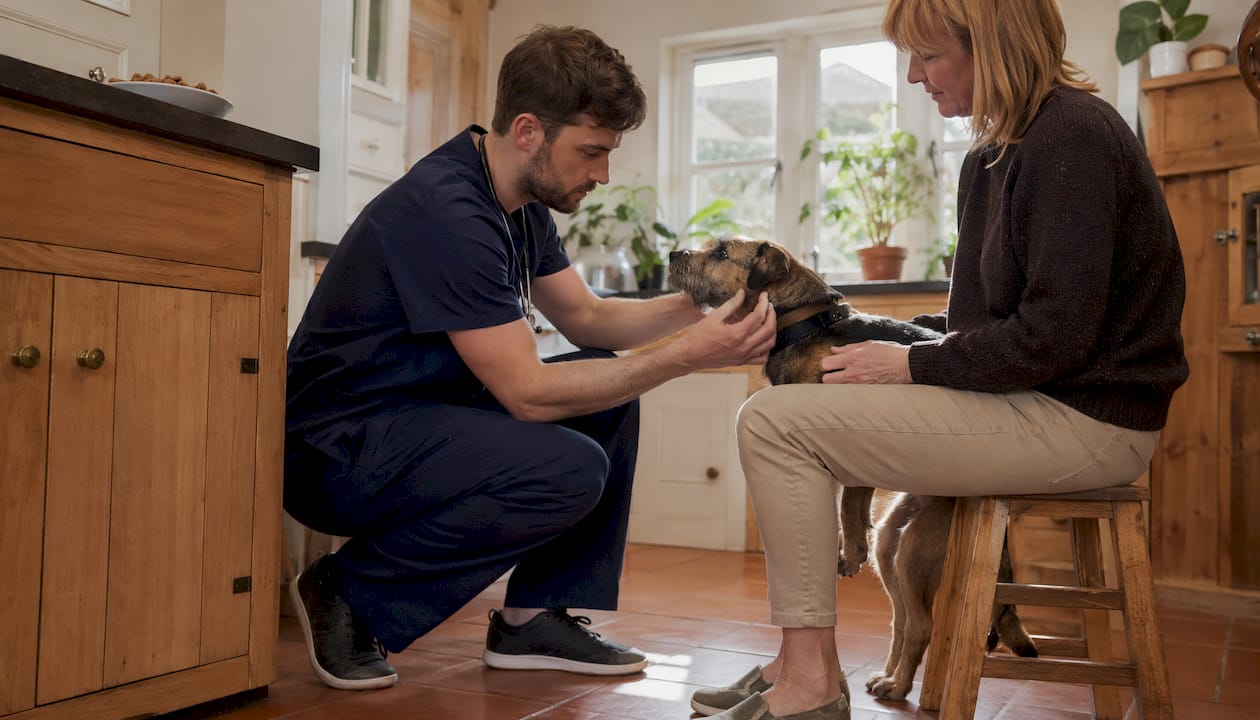
Forcing interactions is another frequent mistake. Holding a dog still for grooming when it is clearly trying to move away, or pushing a child toward a dog that is leaning back, removes the dog’s ability to communicate discomfort. The dog’s only remaining option is to escalate.
Inconsistent responses to warning signals also erode trust. If a dog growls and is sometimes ignored, sometimes punished, and sometimes rewarded with being left alone, it cannot predict what will happen. Unpredictability increases anxiety, and anxiety raises the bite threshold. Clear, consistent, kind responses to early warning signals teach the dog that communication works, which keeps the ladder of aggression from being climbed in the first place.
UK legal responsibilities when your dog bites
Under the Dangerous Dogs Act 1991, it is a criminal offence in England and Wales for a dog to be dangerously out of control in any place, including private property. This applies regardless of breed. A dog is considered dangerously out of control if it injures someone or if a person has reasonable grounds to believe it may do so.
Owners can face prosecution, a criminal record, a fine, or imprisonment. Courts can also order the dog to be kept under specific conditions, neutered, muzzled in public, or in serious cases, destroyed. The law was extended in 2014 to include incidents on private property, meaning a bite that occurs in your own home or garden can still result in prosecution.
Practically, this means:
You are responsible for your dog’s behaviour in all settings.
If your dog bites someone, you should document the incident carefully and seek legal advice if a complaint is made.
Home insurance policies with public liability cover can provide some protection; check your policy.
Notifying your vet and seeking a behaviour assessment demonstrates responsible ownership, which can be relevant in any legal proceedings.
This article provides general information only, not legal advice. For your specific situation, consult a solicitor or contact Citizens Advice.
Key takeaways
Dogs almost never bite without prior warning; the signals are simply missed, misread, or suppressed by owners who did not know what to look for.
Point | Details |
Bites follow a warning sequence | The ladder of aggression shows dogs escalate through calming signals, avoidance, and tension before biting. |
Medical causes must be ruled out | Sudden or uncharacteristic biting warrants a veterinary check before any behaviour programme begins. |
Punishing growling increases bite risk | Removing warning signals does not remove discomfort; it removes the dog’s ability to communicate it. |
Management reduces risk immediately | Safe spaces, gates, supervised interactions, and lead use lower bite risk while training is under way. |
UK law applies in all settings | Under the Dangerous Dogs Act 1991, owners are legally responsible for their dog’s behaviour at home and in public. |
Living safely with a dog who has bitten: a note from Mark
If your dog has bitten someone, the fear and confusion you are feeling right now are completely understandable. A bite changes things, and it is natural to question everything. But a bite is also information, and with the right support, most dogs and families can move forward safely and confidently.
The first step is always the same: get a veterinary check, document what happened, and resist the urge to punish or suppress the behaviour that preceded the bite. From there, a qualified behaviourist can help you build a clear picture of what your dog needs and what realistic progress looks like.
At Happy-dogtraining, we work with dogs and owners using humane, science-based methods that respect both the dog’s communication and the family’s safety. If your dog has shown signs of aggression or has bitten, a fearful dog rehabilitation programme or a personalised behaviour consultation may be the right starting point. You do not have to navigate this alone.

Ready to take the next step? Happy-dogtraining offers personalised behaviour consultations and structured programmes designed around your dog’s individual needs. Reach out today and let’s work through this together.
Useful UK resources for dog bite guidance and support
These organisations provide reliable, country-specific information across behaviour, first aid, legal responsibilities, and finding accredited professionals.
RSPCA (rspca.org.uk/adviceandwelfare/pets/dogs/behaviour/aggression): Covers dog aggression, the ladder of aggression, and when to seek professional help. A good first stop for behaviour guidance.
PDSA (pdsa.org.uk): Offers practical advice on dealing with dog attacks, managing aggression, and finding veterinary support. Useful for both immediate response and longer-term planning.
Dogs Trust (dogstrust.org.uk): Provides free behaviour resources, training guides, and a behaviourist referral service. Particularly helpful for owners of rescue dogs.
Blue Cross (bluecross.org.uk): Covers dog behaviour, body language, and when to seek professional support, with accessible guides suitable for all owners.
NHS 111 (111.nhs.uk): For human injuries from dog bites. Call 111 or visit the website for first aid guidance and to assess whether you need urgent medical attention.
Association of Pet Behaviour Counsellors (APBC) (apbc.org.uk): Directory of accredited behaviourists in the UK. Use this to find a qualified professional near you.
Citizens Advice (citizensadvice.org.uk): For guidance on the legal implications of dog bites under UK law, including the Dangerous Dogs Act 1991.
Urgent issues: For a human injury, contact NHS 111 or go to A&E. For sudden behaviour changes in your dog, call your vet. For behaviour guidance and finding accredited support, start with the RSPCA, Dogs Trust, or APBC.
Recommended
Comments