Why trainer assessment precedes boarding: a clear guide

Trainer assessment before boarding is a professional evaluation of your dog’s behaviour, temperament, and training history conducted before any boarding or board-and-train programme begins. This process is not a formality. It is the foundation that determines whether a boarding placement will be safe, effective, and genuinely useful for your dog. Without it, trainers are working blind, and your dog pays the price. Understanding why trainer assessment precedes boarding helps you make better decisions and choose programmes that actually deliver lasting results.
Why trainer assessment precedes boarding
A training programme without formal assessment is merely a presentation. That distinction matters enormously when you are entrusting your dog to someone for days or weeks at a time. Assessment gives the trainer objective measures of where your dog currently stands, what methods will work, and what risks need managing before the stay begins.
The industry term for this process is a pre-boarding behavioural evaluation, though many owners simply call it an initial consultation or temperament test. Both phrases refer to the same structured process. Reputable boarding and training facilities offer a free initial assessment lasting 30–60 minutes before accepting dogs, using that time to establish behavioural fit and set customised goals. That investment of time upfront prevents far costlier problems later, including regression, stress, and unsafe placements.

The assessment also serves a second purpose that owners rarely consider. Because dog training in Singapore and many other countries is not formally licensed, the pre-boarding assessment acts as an interview for the trainer’s competency and ethical standards. It is one of the clearest signals you will get about whether a trainer is worth trusting with your dog.
What do trainers actually evaluate before boarding?
The evaluation covers six core areas, each of which directly shapes the boarding plan. Industry guidance identifies these six metrics as standard for pre-boarding evaluations:
Temperament. Is your dog generally confident, anxious, or somewhere in between? Temperament determines which training methods will be most effective and how quickly your dog is likely to settle.
Confidence level. A dog with low confidence needs a very different environment from one that is bold and curious. Misreading this leads to either under-stimulation or overwhelm.
Stress triggers. Loud noises, unfamiliar dogs, new people, or specific handling can all trigger stress responses. Identifying these before boarding prevents avoidable setbacks.
Household environment. What rules does your dog live by at home? A trainer needs to know this to maintain consistency rather than accidentally undoing your existing routines.
Training history. Has your dog had any prior obedience work, marker training, or reward-based training? This shapes which commands and cues the trainer can build on immediately.
Lifestyle goals. What do you actually want your dog to be able to do after boarding? Realistic goal-setting starts here, not after the stay ends.
Each of these factors feeds directly into the boarding plan. A dog with a history of fearfulness, for example, needs a very different daily structure from a confident, sociable dog. Skipping this evaluation means the trainer is guessing, and guessing with someone else’s dog is never acceptable.
How does assessment shape a customised training plan?
Assessment data is the raw material for every good training plan. Without it, trainers apply generic methods that may not suit your dog’s behavioural profile at all. Initial consultations evaluate personality and reactivity to determine suitability for specific programmes and avoid ineffective or risky placements. That is a practical safeguard, not a sales step.
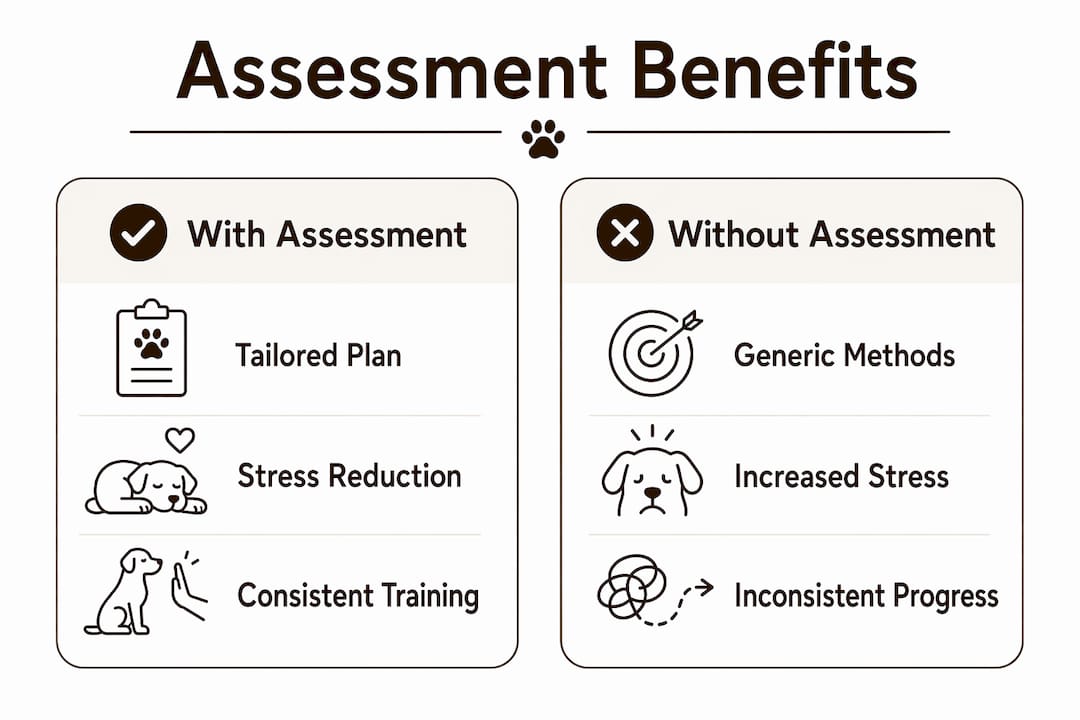
When a trainer knows your dog’s confidence level, stress triggers, and training history, they can match their methods precisely. A dog that responds well to reward-based training does not need pressure-based techniques. A dog with reactivity issues needs careful socialisation protocols rather than open group play. The assessment makes these distinctions clear before day one.
Trainer qualifications also matter here. An AVS-accredited trainer, such as those at Happy-dogtraining, brings a structured framework to the evaluation. That accreditation signals that the trainer’s methods meet recognised standards, which gives you confidence that the assessment itself is thorough and the resulting plan is grounded in sound canine behaviour science.
Pro Tip: Ask your trainer to share the assessment findings in writing before the boarding stay begins. A good trainer will have clear notes on your dog’s temperament, identified triggers, and the specific methods they plan to use. If they cannot produce this, treat it as a warning sign.
You can also explore how to customise a training plan for your dog to understand how assessment data translates into daily training decisions during a boarding stay.
Why does consistency during boarding depend on prior assessment?
Consistency is the single most important factor in whether a dog retains what it learns during boarding. Trainer-led boarding must be an extension of the dog’s training environment to prevent confusion and maintain progress. Without an assessment, the trainer has no baseline to extend from.
When a dog moves into a boarding environment without a prior evaluation, the change in routine, people, and expectations can cause confusion. That confusion often shows up as regression, where previously learned behaviours deteriorate because the dog cannot predict what is expected. The table below illustrates how assessment-informed boarding compares to boarding without prior evaluation.
Factor | With prior assessment | Without prior assessment |
Routine consistency | Trainer replicates home cues and rules | Trainer applies generic structure |
Stress management | Triggers identified and avoided | Triggers discovered reactively |
Training continuity | Builds on existing commands | May conflict with prior learning |
Regression risk | Low, due to familiar expectations | High, due to environmental mismatch |
Owner handover | Clear, documented progress notes | Vague or verbal summary only |
The difference is not subtle. Dogs that board where their training environment is understood and respected show measurably better retention. Those placed without assessment often return home needing remedial work rather than showing progress.
What are the signs of a high-quality trainer assessment?
Knowing what a good assessment looks like helps you choose the right programme. A thorough pre-boarding evaluation has five clear markers.
Clear explanation of daily structure. The trainer describes exactly how many training sessions occur each day, how long they last, and what the dog does between sessions. Vague answers here are a red flag.
Transparency about training methods. The trainer explains whether they use reward-based training, marker training, or other approaches, and why those methods suit your dog specifically.
Specific observation of your dog. The trainer watches how your dog moves, reacts to strangers, responds to handling, and settles in a new space. They are not just asking you questions; they are watching your dog.
Documentation of findings. A professional assessment produces written notes, not just a verbal chat. These notes form the basis of the boarding plan and the post-boarding handover.
A clear follow-up plan. The trainer explains what happens after boarding, including transfer sessions and owner coaching.
A red flag in any assessment is vague or evasive answers about daily training structure and the absence of a clear plan. Transparency about sessions, socialisation time, and decompression periods is non-negotiable.
Pro Tip: Before committing to any boarding programme, ask the trainer: “What happens if my dog shows signs of stress during the stay?” A confident, experienced trainer will have a specific answer. A hesitant or vague response tells you everything you need to know.
Learning how to prepare your dog for board and train can also help you arrive at the assessment session with the right information ready to share.
How do assessments support lasting success after boarding?
The assessment does not end when the boarding stay begins. It also sets the baseline for measuring progress and planning aftercare. Effective board-and-train programmes build in explicit owner training components so that owners receive coaching to maintain progress after boarding ends.
Best practice recommends the following post-boarding steps:
Transfer sessions. At least one private session with the trainer after the stay, where the trainer shows you exactly how to use the cues and methods your dog has learned.
Ongoing private lessons. Experts recommend one private session for every two weeks of boarded training to prevent regression within two to four weeks of returning home.
A post-return follow-up. A check-in session two to four weeks after boarding to assess how well the training is holding at home and adjust the plan if needed.
Written handover notes. A summary of what your dog learned, which cues were used, and what to watch for at home.
Realistic expectation setting during assessments and owner coaching post-boarding are the two factors most strongly linked to preventing regression. The assessment creates the roadmap; the follow-up sessions keep you on it.
Key takeaways
Trainer assessment precedes boarding because it is the only reliable way to match your dog’s behavioural profile to a safe, effective, and consistent training environment.
Point | Details |
Assessment is the foundation | A pre-boarding evaluation identifies temperament, triggers, and training history before any programme begins. |
Six metrics guide the plan | Temperament, confidence, stress triggers, environment, training history, and lifestyle goals all shape the boarding structure. |
Consistency depends on assessment | Trainers can only maintain familiar expectations and prevent regression if they know your dog’s baseline. |
Quality assessments are documented | Written findings, clear daily structure, and a follow-up plan are markers of a professional evaluation. |
Aftercare is part of the process | One private session per two weeks of boarding, plus a post-return follow-up, prevents skills from fading at home. |
What I have learned after years of watching boarding go wrong
The dogs that struggle most after boarding are almost never the ones with the hardest behavioural challenges. They are the ones whose trainers skipped a proper assessment. I have seen confident, sociable dogs return home anxious and withdrawn simply because the boarding environment did not account for their specific stress triggers. I have seen reactive dogs placed in open group settings because no one evaluated their reactivity beforehand.
What strikes me most is how often owners feel they cannot ask questions during an assessment. They worry about seeming difficult or mistrustful. My honest advice: ask everything. Ask how many sessions happen each day. Ask what the trainer will do if your dog refuses to eat. Ask what “socialisation” actually means in practice at that facility. A trainer who bristles at these questions is telling you something important.
The assessment is also where trust is built, not just information gathered. When a trainer takes time to observe your dog carefully, explains their reasoning clearly, and gives you honest feedback about what your dog is and is not ready for, that is the moment you know you are in good hands. That trust carries through the entire boarding stay and into the follow-up sessions afterwards. Without it, you are simply hoping for the best.
— Mark
Happy-dogtraining’s approach to pre-boarding assessment

Happy-dogtraining offers a free initial consultation that covers all six core assessment metrics, giving you a clear picture of your dog’s behavioural profile before any boarding commitment is made. The AVS-accredited trainer brings over 20 years of experience to every evaluation, using science-based, reward-based methods tailored to each dog’s individual needs. After boarding, structured transfer sessions ensure you know exactly how to maintain your dog’s progress at home. Transparent communication throughout means no surprises and no vague handovers. If you want a boarding programme built on a thorough, honest assessment, explore Happy-dogtraining’s services and take the first step with confidence.
FAQ
Why does trainer assessment come before boarding?
Trainer assessment identifies your dog’s temperament, stress triggers, and training history before boarding begins. This ensures the programme is safe, consistent, and matched to your dog’s specific needs.
How long does a pre-boarding assessment take?
Reputable facilities typically conduct assessments lasting 30–60 minutes, and many offer this initial consultation free of charge to lower barriers for owners.
What happens if a dog skips the assessment?
Without a prior evaluation, trainers apply generic methods that may conflict with your dog’s existing training or trigger stress responses. Regression after boarding is significantly more likely as a result.
How do I know if a trainer’s assessment is thorough?
Look for written documentation of findings, a clear explanation of daily training structure, and a specific follow-up plan. Vague or evasive answers about daily sessions are a clear warning sign.
How many follow-up sessions does my dog need after boarding?
Best practice recommends one private session for every two weeks of boarded training, plus a post-return check-in two to four weeks after your dog comes home.
Recommended
Comments